Custom Search
|
|
  |
|
|
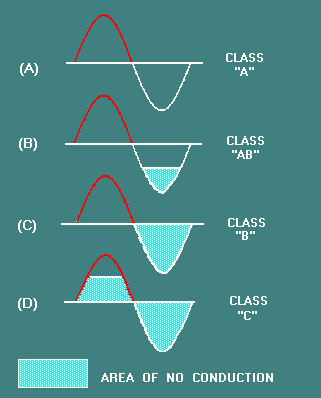
AMPLIFIER CLASSES OF OPERATION In the previous discussions, we assumed that for every portion of the input signal there was an output from the amplifier. This is not always the case with amplifiers. It may be desirable to have the transistor conducting for only a portion of the input signal. The portion of the input for which there is an output determines the class of operation of the amplifier. There are four classes of amplifier operations. They are class A, class AB, class B, and class C. Class A amplifiers are biased so that variations in input signal polarities occur within the limits of CUTOFF and SATURATION. In a PNP transistor, for example, if the base becomes positive with respect to the emitter, holes will be repelled at the PN junction and no current can flow in the collector circuit. This condition is known as cutoff. Saturation occurs when the base becomes so negative with respect to the emitter that changes in the signal are not reflected in collector-current flow. Biasing an amplifier in this manner places the dc operating point between cutoff and saturation and allows collector current to flow during the complete cycle (360 degrees) of the input signal, thus providing an output which is a replica of the input. Figure 2-12 is an example of a class A amplifier. Although the output from this amplifier is 180 degrees out of phase with the input, the output current still flows for the complete duration of the input. The class A operated amplifier is used as an audio- and radio-frequency amplifier in radio, radar, and sound systems, just to mention a few examples. For a comparison of output signals for the different amplifier classes of operation, refer to figure 2-15 during the following discussion. Figure 2-15. - A comparison of output signals for the different amplifier classes of operation.
Class AB Amplifier Operation Amplifiers designed for class AB operation are biased so that collector current is zero (cutoff) for a portion of one alternation of the input signal. This is accomplished by making the forward-bias voltage less than the peak value of the input signal. By doing this, the base-emitter junction will be reverse biased during one alternation for the amount of time that the input signal voltage opposes and exceeds the value of forward-bias voltage. Therefore, collector current will flow for more than 180 degrees but less than 360 degrees of the input signal, as shown in figure 2-15 view B. As compared to the class A amplifier, the dc operating point for the class AB amplifier is closer to cutoff. The class AB operated amplifier is commonly used as a push-pull amplifier to overcome a side effect of class B operation called crossover distortion. Class B Amplifier Operation Amplifiers biased so that collector current is cut off during one-half of the input signal are classified class B. The dc operating point for this class of amplifier is set up so that base current is zero with no input signal. When a signal is applied, one half cycle will forward bias the base-emitter junction and IC will flow. The other half cycle will reverse bias the base-emitter junction and IC will be cut off. Thus, for class B operation, collector current will flow for approximately 180 degrees (half) of the input signal, as shown in figure 2-15 view C. The class B operated amplifier is used extensively for audio amplifiers that require high-power outputs. It is also used as the driver- and power-amplifier stages of transmitters. Class C Amplifier Operation In class C operation, collector current flows for less than one half cycle of the input signal, as shown in figure 2-15 view D. The class C operation is achieved by reverse biasing the emitter-base junction, which sets the dc operating point below cutoff and allows only the portion of the input signal that overcomes the reverse bias to cause collector current flow. The class C operated amplifier is used as a radio-frequency amplifier in transmitters. From the previous discussion, you can conclude that two primary items determine the class of operation of an amplifier - (1) the amount of bias and (2) the amplitude of the input signal. With a given input signal and bias level, you can change the operation of an amplifier from class A to class B just by removing forward bias. Also, a class A amplifier can be changed to class AB by increasing the input signal amplitude. However, if an input signal amplitude is increased to the point that the transistor goes into saturation and cutoff, it is then called an OVERDRIVEN amplifier. You should be familiar with two terms used in conjunction with amplifiers - FIDELITY and EFFICIENCY. Fidelity is the faithful reproduction of a signal. In other words, if the output of an amplifier is just like the input except in amplitude, the amplifier has a high degree of fidelity. The opposite of fidelity is a term we mentioned earlier - distortion. Therefore, a circuit that has high fidelity has low distortion. In conclusion, a class A amplifier has a high degree of fidelity. A class AB amplifier has less fidelity, and class B and class C amplifiers have low or "poor" fidelity. The efficiency of an amplifier refers to the ratio of output-signal power compared to the total input power. An amplifier has two input power sources: one from the signal, and one from the power supply. Since every device takes power to operate, an amplifier that operates for 360 degrees of the input signal uses more power than if operated for 180 degrees of the input signal. By using more power, an amplifier has less power available for the output signal; thus the efficiency of the amplifier is low. This is the case with the class A amplifier. It operates for 360 degrees of the input signal and requires a relatively large input from the power supply. Even with no input signal, the class A amplifier still uses power from the power supply. Therefore, the output from the class A amplifier is relatively small compared to the total input power. This results in low efficiency, which is acceptable in class A amplifiers because they are used where efficiency is not as important as fidelity. Class AB amplifiers are biased so that collector current is cut off for a portion of one alternation of the input, which results in less total input power than the class A amplifier. This leads to better efficiency. Class B amplifiers are biased with little or no collector current at the dc operating point. With no input signal, there is little wasted power. Therefore, the efficiency of class B amplifiers is higher still. The efficiency of class C is the highest of the four classes of amplifier operations. Q.22 What amplifier class of operation allows collector current to flow during the
complete cycle of the input? |
 |
|
|
Integrated Publishing, Inc. - A (SDVOSB) Service Disabled Veteran Owned Small Business
|