Custom Search
|
|
 
|
||
|
When light strikes a medium and is neither reflected nor transmitted (passed on), it is said to be absorbed. Black cloth or areas of dark forest, for instance, absorb more light than objects such as a white sheet or a coral sand beach. When light comes in contact with the surface of an object, a certain degree of reflection, and some absorption, always takes place. A medium that does not allow light to pass through it is opaque. An opaque material may also reflect light. When an object is opaque and the light is not reflected, it is absorbed by the object. When light is absorbed, its energy is converted and it no longer exists as light. The color of an object is determined by the way it absorbs light falling upon it (incident light). A woman's dress appears red when it absorbs the blue and green rays of white light and reflects the red waves. A lawn appears green because the grass blades absorb the red and blue rays of light and reflect the green rays. Neutral colors, such as white, black, and the various tones or values of gray, actually absorb almost equal proportions of the colors of light. Varying reflective powers account for their differences. White is highly reflective, while an object of absolute blackness, no matter how much light falls on it, can never be recorded on film except by contrast.
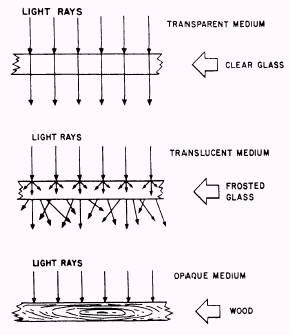
Figure 1-7. Effects of different media. TRANSMISSION In addition to being reflected and absorbed, light rays may be transmitted. They may also pass through some medium they encounter. When objects can be clearly seen through the medium, the medium is transparent. A transparent medium transmits light rays in a regular, or uniform, pattern. When the medium transmits light but breaks up the orderliness of the pattern, sending the transmitted rays in many directions, the medium is translucent. In other words, a medium is said to be translucent when light is visible through it, but objects are NOT clearly distinguishable. Thin fabrics and frosted glass are examples of translucent materials that allow the passage of diffused light (fig. 1-7). One important form of transmission is termed refraction. |
 |
|
|
||