Custom Search
|
|
 
|
||
|
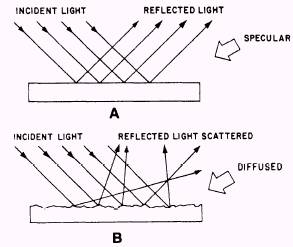
Light waves travel in straight lines. When light waves encounter an object or new medium, they act in one or more of the following ways: They may be reflected. They may be absorbed. They may be transmitted. When light is reflected, it acts in a certain way. When the reflecting surface is smooth and polished, the reflection is orderly, or specular. Specular light is reflected at the same angle to the surface as the light incident to the surface; that is, the path of the light reflected from the surface forms an angle exactly equal to the one formed by its path in reaching the surface. Thus the angle of reflection is equal to the angle of incidence, which is a characteristic of specular light (fig. 1-6, view A). However, when the object surface is not smooth and polished but irregular, light is reflected irregularly or diffused (fig. 1-6, view B); that is, the light is reflected in more than one direction. Practically all surfaces reflect both specular and diffused light; smooth surfaces reflect more specular light, and rough surfaces more diffused light. Since diffused light is more common than specular light, it is of greatest value in photography. Objects that are not light sources are visible and therefore photographic.
Figure 1-6. Reflected light. only because they reflect the light that reaches them from some luminous source. |
 |
|
|
||