Custom Search
|
|
 
|
||
|
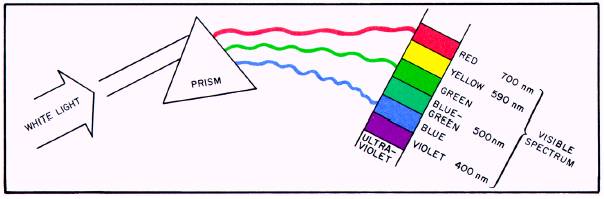
White light is made up of nearly equal intensities of all wavelengths within the visible spectrum. By passing white light through a prism, scientists have found that light sources have many qualities. They are as follows: Different wavelengths are present in the sources of radiant energy. The frequency and color of wavelengths vary. C302.8
Figure 1-5. Refraction of light by a prism. With each wavelength, there is a variation in the amount of energy. This variation of energy is called spectral energy distribution. The spectral energy of a light source is represented by color temperature. These terms are used in photography to describe and define the sources of light being used. Color temperature describes the color quality of a light source in terms of the amounts of red light and blue light. Color temperature is based on what is called a Planckian radiator, or simply a black body. As the temperature of the metal of the black body is raised, it goes from a dull black through red and orange to blue and finally to white heat. The quality of the light emitted is a function of the temperature of the metal. When the object is red-hot, the color temperature is low since red is at the low end of the scale; and when it is blue-white, the color temperature is high. However, the temperature at which a light source is burned does not control color temperature; for example, a fluorescent tube burns at a low 125F, yet it has a high color temperature. Color temperature then is raised or lowered relatively by the amount of visible white light radiated from the source. Be careful not to get confused. Traditionally reddish light is known as warm and bluish light as cold; in actuality, the color temperatures is the other way around. The most convenient way to describe the color temperature of a light source is by its Kelvin temperature. From a practical point of view, this term refers to the degree of whiteness of the light. Color temperature is measured on the Kelvin scale and is stated as Kelvin temperature. On the temperature scale, 0 K is the same as -273C. Therefore, degrees Kelvin (K) are always 273 degrees higher than the same temperature on the Celsius scale. Thus a red-hot piece of iron with an approximate temperature of 2000C has a color temperature of 2273 K. As the Celsius temperature of an object is raised, it emits a whiter light and produces a relatively higher color (Kelvin) temperature. COLOR RELATIONSHIPS Many ways have been devised to classify the colors we see. Though terminology may differ, it is generally agreed that color can be defined by three qualities: hue, brightness, and saturation. Hue-Hue is the actual color or wavelength reflected by an object-red, yellow, green, and so forth. For example, it could be said that the color of an object is blue. Blue identifies the hue. There are seven hues in the visible spectrum. These seven hues are as follows: blue, green, red, cyan, magenta, yellow, and white. Hue, however, is an inadequate description of a cola. To be more specific, we should say that an object is dark blue or light blue. Now we have described the brightness of the color. Brightness-The brightness of a color is independent of the hue. Two colors may have the same hue but different brightness. Thus, to describe a color or brightness, we say that it is dull, bright, vivid, or brilliant. Saturation-The saturation of a color is the degree to which the color departs from neutral gray of the same brightness. You can think of it as mixing black, gray, or white paint with a colored paint, thus diluting the color. In other words, saturation is a measure of color purity. |
 |
|
|
||