Custom Search
|
|
 
|
||
|
The change of direction that occurs when a ray of light passes from one transparent substance into another substance of different density is called refraction. Refraction enables a lens to form an image. Without refraction, light waves behave as X rays and pass in straight lines through all suitable substances without any control of direction, and only shadow patterns can be made with them. Refraction occurs because light travels at different speeds in different transparent substances. The speed of light in each transparent substance is called
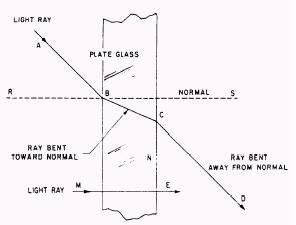
Figure 1-8. The law of refraction. the index of refraction for that substance; for example, light travels about 1 1/2 times as fast in air as it does in glass, so the index of refraction for glass is about 1.5. Refraction, or change of direction, always follows a simple rule. In passing from one transparent substance into another of greater density, refraction is toward the normal. In passing from one transparent substance into another of lesser density, refraction is away from the normal. In this rule the normal is defined as a line perpendicular (90) to the surface between the mediums. Refraction is shown in figure 1-8. The ray of light (AB) strikes the glass at an oblique angle. Since the glass is denser than air, the ray of light is bent toward the normal (RS) and emerges from the glass at (C). Upon entering the air again, the ray is bent away from normal (RS) and travels along the path (CD). All rays striking the glass at an angle other than perpendicular are refracted. In the case of the perpendicular ray (ME) that enters the glass normal to the surface, no refraction takes place and the ray continues through the glass and into the air in a straight line. The speed of light in a medium depends on the wavelength of the light. As light enters a more dense medium, the short waves, such as blue, are slowed more than the long waves, such as red. Thus the index of refraction of a medium varies with the wavelength, and the different colors of light are bent different amounts. This changing index of refraction or the breaking up of white light into its component colors is called
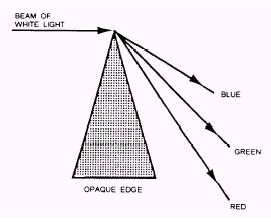
Figure 1-9. Diffraction. dispersion. This then ties in with the previous discussion of the colors of light where we saw the way a prism creates a spectrum from white light. The prism is able to create this spectrum because of dispersion. |
 |
|
|
||