Custom Search
|
|
 
|
||
|
For most product photography, the first light to be placed is the main light, then lights to create highlights are added, and finally any fill lights. However, the order in which the lights are placed depend somewhat on the subject to be photographed. When, for example, the product is tented, the procedure should be to establish an overall, high level of illumination first. Other lights should then be added to better show shape, form, and bulk of the subject. You should always start your lighting setup with the main light. The usual position for the main light in product photography is high and somewhat behind the subject. The position of this light is very important. To establish this light, you should do the following: 1. Darken the set. 2. Through the camera ground glass, view the effect of the main light on the subject. Have an assistant move the main light in the general area previsualized for the main light. Establish the main light in a position where it produces the most pleasing and desired effect. Remember, the farther the main light is from the subject, the smaller the highlights and the sharper the edges of the shadows. As the light is moved, notice the change in highlight and shadow areas. It is important for you to observe the effect of the lighting (through the ground glass) exactly as the camera will see it. The characteristics of the main light greatly influence the overall quality of the picture. 3. Add secondary spotlights as needed to create highlights and texture. Highlights other than those produced by the main light may be needed to help separate and define subject planes as well as to separate the subject from the background or its surroundings. By using secondary spotlights in a crosslighting or skimming manner, you can emphasize the surface texture of the subject. Establishing the secondary lights to produce the desired highlights and texture is more time-consuming than positioning either the main or the fill lights. When the subject is a complex shape or has many planes, several small, secondary lights may be needed. 4. And finally, once the main light and highlights have been established, the fill-in illumination is applied to provide the appropriate shadow detail. The fill light illumination is usually supplied by one or more diffused floodlights or reflectors. Care must be taken to ensure that the fill-in lighting does not cast distinguishable shadows. This problem can generally be solved by positioning the fill lights close to the camera and at a low angle or about tabletop height. Every light you use in product photography should have a definite purpose in creating the final photograph. A dominant light source must prevail without undue competition from other light sources. If the addition of a new light creates new problems, then start over again. Remember, the simplest approaches to product lighting are the best. Whenever you light the set for small product photography, you must keep lighting ratios in mind. A 302.187
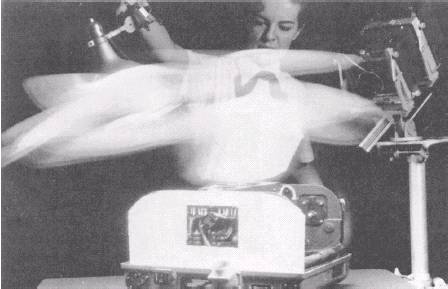
Figure 6-11. Using painted light. useful range between highlights and shadows, in which the film can record detail, must be established. This useful range depends completely on the reflectance range of the subject. With most color films, this range between highlights and shadows must be kept within five f/stops. This means a ratio of about 32:1. Any area of the subject (except specular highlights) that is outside of this range is reproduced either too light or too dark in the final picture. A reflected light meter can be used to find the relationship between the useful or desired diffused highlight and the darkest desired shadow. A difference of two f/stops is a scene contrast of 4: 1; four stops is a 16:1 contrast. Most black-and-white film can record both highlight and shadow detail when this range is not greater than about six f/stops. Painted Light Painted light (fig. 6-11) is one of the best ways to obtain even illumination and soft shadows. With this type of lighting, only one light is used. The light is moved constantly up and down and around the subject and its background. Painted light is effective for illuminating subjects made up of many smaller parts that cast shadows onto adjacent parts, such as printed circuits or the inside of a radio. When you are using the painted light technique, the exposure must be increased by a factor of 3. To determine the painted light exposure, hold the light stationary at the same distance it will be used from the subject. Read the exposure with your light meter. Multiply the exposure time indicated by the meter by 3, the painted light factor. Example: With the light meter, you have determined the exposure to be 6 seconds. Multiply the exposure time, 6 seconds, by the painted light factor, 3 (6 x 3 = 18 seconds). The minimum exposure time required when using painted light is 10 seconds. An exposure of less than 10 seconds does not give the photographer enough time to illuminate the subject evenly. |
 |
|
|
||