Custom Search
|
|
 
|
||
|
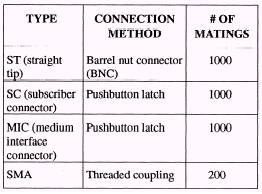
FIBER-OPTIC CONNECTORS.\ Like electrical cable connectors, different types of fiber-optic connectors have different kinds of attachment mechanisms. The actual attachments between ferrule shells may be made by threading, snapping, or clicking. Table 2-2 lists the most commons types of fiber-optic connectors.
Table 2-2.\Fiber-optic connectors. In addition to attachment mechanisms, fiber-optic connectors differ in the following ways: l l The size of the ferrule. Whether the connector can be keyed. This is the technique for making a connector asymmetrical, usually by adding a notch or plug, making it impossible to plug the connector in wrong. The number of matings the connectors can handle without producing unacceptable signal loss. l l Whether the fiber must be twisted to make the connection; multiple fibers cannot run through the same connector if it is to be twisted. The connectors differ in the way the fiber is attached to the connector itself. You can either use epoxy to glue the fiber into the connector, or you can crimp the connector and the ferrule together using a special crimping tool. CONNECTOR GENDERS.\ Connector gender basically refers to whether a connector has plugs or sockets. The gender is important because the elements being connected must have complementary genders. A male connector is known as a plug; the female connector is known as a jack. With a few exceptions, such as the IBMR data connectors and certain fiber-optic connectors, all connector types have distinct genders. Figure 2-5 shows examples of male and female connectors. CONNECTOR MECHANISMS.\ The connection mechanism defines how the physical contact is made to allow the signal to pass from one side of the connection to the other. Connection mechanisms differ in how sturdy they are. For example, the pin-and-socket connection at a serial port can be wobbly without extra support from the screws on either side of the plug. On the other hand, fiber-optic connectors must be cut to precise proportions and must not allow any play in the connection. INSPECTING COMPONENTS The inspection of the components when they are received is limited to checking for any physical damage. This damage will include: . Any damage to the packing material l Damage to the case . Hidden damage on the inside of the cabinet The inspection that is conducted needs to be as thorough as possible, since any damage discovered must be reported to the supplier. This inspection also needs to be accomplished as soon as the equipment arrives, because the longer you wait, the less likely it becomes that the supplier will replace the equipment. |
 |
|
|
||