Custom Search
|
|
 
|
||
|
NETWORK TESTING Network testing is changing significantly because of the growth of digital network capability. Testing in the voice network has always been considered as much of an art as a science because of the variable nature of the different impairments encountered. The digital net work has been designed with more diagnostic capability, making it much easier to identify and isolate problems. The testing is done in the carrier environment, not in the user environment. Network Testing Methods There are three basic approaches to network testing, as follows:
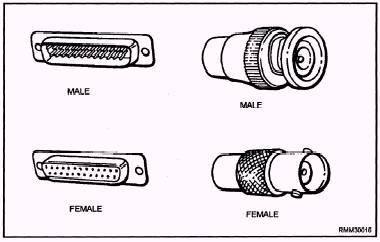
Figure 2-5.\Connector genders. 1. Rely on vendors. If you rely on a vendor for testing, you probably have a single vendor's products in your network and are, therefore, locked into that vendor. Fewer vendors today are capable of providing this complete capability. 2. Use an organization dedicated to network problem solving (third party). At one time, third-party problem solving was considered a viable alternative, but today the expertise needed is so vast and covers such a wide variety of products that it is not feasible to provide the service. The carrier providing the majority of your circuits is the best for handling your network management. However, it is difficult for the carrier to be objective, and it is usually not very cost effective. 3. Use in-house network management. In-house network control is by far the most flexible in design and operation. Network administrators typically understand their problems better than any carrier or vendor could. Network problems are not always the result of network conditions; they may actually be operational problems. A disadvantage of in-house network control is that it requires more resources, such as knowledgeable people, equipment, space, and all of the other support overhead. Regardless of the testing method that is used, testing can be performed by both hardware tools and software programs. Hardware Testing The tools used are partly insurance and partly convenience devices. The greatest expense of a network comes when it is down or functioning incorrectly; it is important to be able to test components when things go wrong. Testing should also be accomplished before installing, to ensure that you do not install a faulty component. After they are installed, test components periodically to make sure they are functioning properly. Special tool are available for this purpose. Network testers can be very expensive, while convenience tools, such as wire crimpers and voltmeters, are quite inexpensive. The amount that is spent on tools will depend on the size of the network, the importance of the network's contents, and who will be doing the maintenance on the network. The following are several types of hardware tools: l Manufacturing tools for creating individual components, such as crimpers and dies for attaching wires to connectors. l Construction tools for assembling and disassembling systems; for example, screwdrivers, pliers, chip removers, and chip installers. l Testing tools for testing individual components or for monitoring the performance of a component or system, such as voltmeters, ammeters, and line scanners. l Safety tools for making sure components are protected against damage from electrical and other dangers; for example, static cords, electrical mats, and shorting probes. BASIC TOOLS.\ The level and range of tools you will need depends on the level of your involvement with the network. Regardless of the level, a few basic tools will almost certainly make your life easier: l Screwdrivers, for opening machines, installing and removing expansion cards, and for attaching connectors; l Pliers, for grasping objects; l Wrenches or nut drivers, for tightening and loosening nuts; l Chip removers/installers, for removing and installing computer chips; and l Tweezers, for retrieving small parts and screws. In addition to these tools, some people might also have wire strippers, cutters, and soldering irons that can be used to set up special-purpose circuits or wiring connectors. If you are going to do any troubleshooting at all, you will need a voltmeter or ammeter (probably both), with an operator's manual, to test the electrical activity. Use of the manual is essential to connect the meter properly; connecting the meter wrong can cause serious damage to sensitive circuitry. TOOLS FOR INSTALLING AND ATTACHING CABLE.\ The tools used in making cables are specialized tools. They are used to attach the connectors onto the cable and then to test the cable. It is advisable to get the cables pre-made to the desired length by the manufacturer. Unfortunately, that isn't always possible. To attach connectors to cable, you need the following tools: connector together, and l a crimping tool, for pressing the cable and l a die for the specified cable/connection pair, to make sure cable and connector fit properly. Installation tool kits that include the crimping tool, die, cable, connectors, and cable ties can be purchased from manufacturers. These kits range in price from one or two hundred to several thousand dollars. |
 |
|
|
||