Custom Search
|
|
  |
|
|
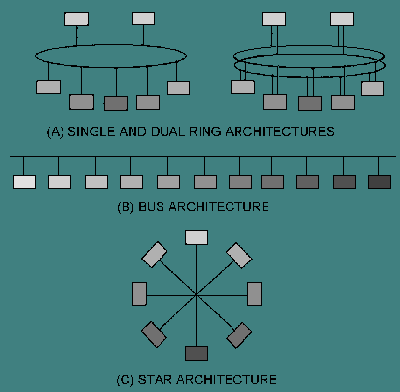
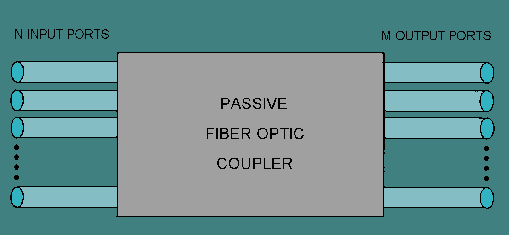
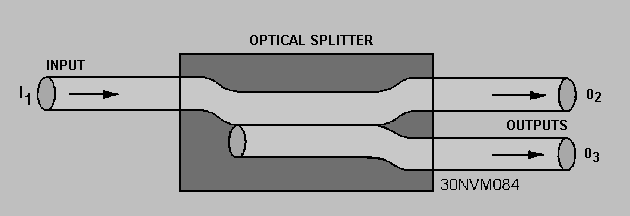
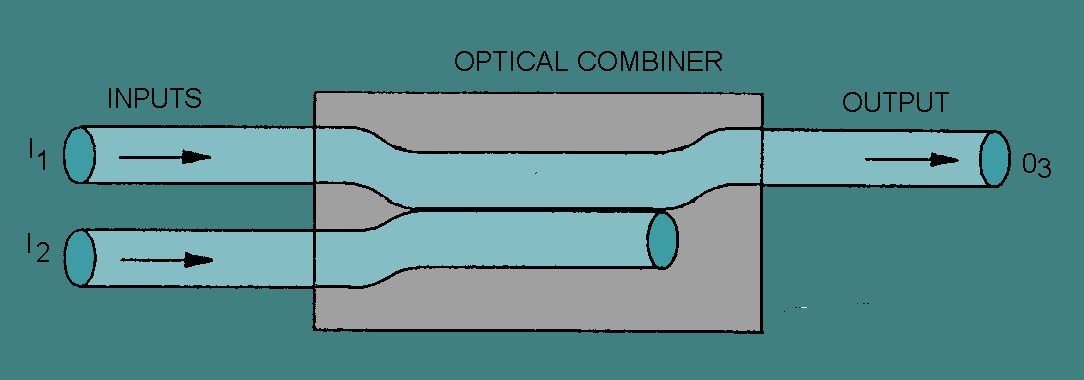
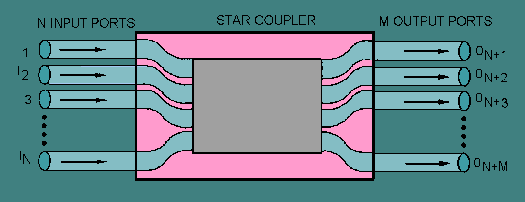
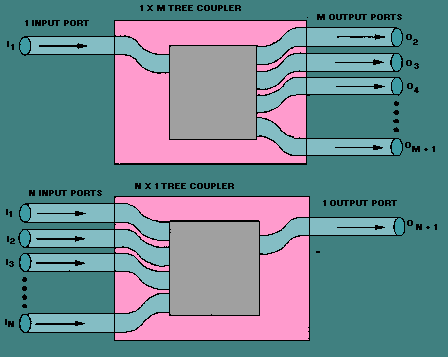
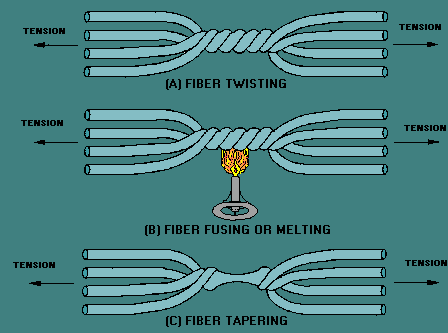
FIBER OPTIC COUPLERS Some fiber optic data links require more than simple point-to-point connections. These data links may be of a much more complex design that requires multi-port or other types of connections. Figure 4-23 shows some example system architectures that use more complex link designs. In many cases these types of systems require fiber optic components that can redistribute (combine or split) optical signals throughout the system. Figure 4-23. - Examples of complex system architectures. One type of fiber optic component that allows for the redistribution of optical signals is a fiber optic coupler. A fiber optic coupler is a device that can distribute the optical signal (power) from one fiber among two or more fibers. A fiber optic coupler can also combine the optical signal from two or more fibers into a single fiber. Fiber optic couplers attenuate the signal much more than a connector or splice because the input signal is divided among the output ports. For example, with a 1 X 2 fiber optic coupler, each output is less than one-half the power of the input signal (over a 3 dB loss). Fiber optic couplers can be either active or passive devices. The difference between active and passive couplers is that a passive coupler redistributes the optical signal without optical-to-electrical conversion. Active couplers are electronic devices that split or combine the signal electrically and use fiber optic detectors and sources for input and output. Figure 4-24 illustrates the design of a basic fiber optic coupler. A basic fiber optic coupler has N input ports and M output ports. N and M typically range from 1 to 64. The number of input ports and output ports vary depending on the intended application for the coupler. Types of fiber optic couplers include optical splitters, optical combiners, X couplers, star couplers, and tree couplers. Figure 4-24. - Basic passive fiber optic coupler design. An optical splitter is a passive device that splits the optical power carried by a single input fiber into two output fibers. Figure 4-25 illustrates the transfer of optical power in an optical splitter. The input optical power is normally split evenly between the two output fibers. This type of optical splitter is known as a Y-coupler. However, an optical splitter may distribute the optical power carried by input power in an uneven manner. An optical splitter may split most of the power from the input fiber to one of the output fibers. Only a small amount of the power is coupled into the secondary output fiber. This type of optical splitter is known as a T-coupler, or an optical tap. Figure 4-25. - Optical splitter. An optical combiner is a passive device that combines the optical power carried by two input fibers into a single output fiber. Figure 4-26 illustrates the transfer of optical power in an optical combiner. Figure 4-26. - Optical combiner. An X coupler combines the functions of the optical splitter and combiner. The X coupler combines and divides the optical power from the two input fibers between the two output fibers. Another name for the X coupler is the 2 X 2 coupler. Star and tree couplers are multiport couplers that have more than two input or two output ports. A star coupler is a passive device that distributes optical power from more than two input ports among several output ports. Figure 4-27 shows the multiple input and output ports of a star coupler. A tree coupler is a passive device that splits the optical power from one input fiber to more than two output fibers. A tree coupler may also be used to combine the optical power from more than two input fibers into a single output fiber. Figure 4-28 illustrates each type of tree coupler. Star and tree couplers distribute the input power uniformly among the output fibers. Figure 4-27. - Star coupler. Figure 4-28. - (1 X M) and (N X 1) tree coupler designs. Fiber optic couplers should prevent the transfer of optical power from one input fiber to another input fiber. Directional couplers are fiber optic couplers that prevent this transfer of power between input fibers. Many fiber optic couplers are also symmetrical. A symmetrical coupler transmits the same amount of power through the coupler when the input and output fibers are reversed. Passive fiber optic coupler fabrication techniques can be complex and difficult to understand. Some fiber optic coupler fabrication involves beam splitting using microlenses or graded-refractive-index (GRIN) rods and beam splitters or optical mixers. These beamsplitter devices divide the optical beam into two or more separated beams. Fabrication of fiber optic couplers may also involve twisting, fusing, and tapering together two or more optical fibers. This type of fiber optic coupler is a fused biconical taper coupler. Fused biconical taper couplers use the radiative coupling of light from the input fiber to the output fibers in the tapered region to accomplish beam splitting. Figure 4-29 illustrates the fabrication process of a fused biconical taper coupler. Figure 4-29. - Fabrication of a fused biconical taper coupler (star coupler).
Q.31 What is the difference between passive and active fiber optic couplers? |
 |