Custom Search
|
|
  |
|
|
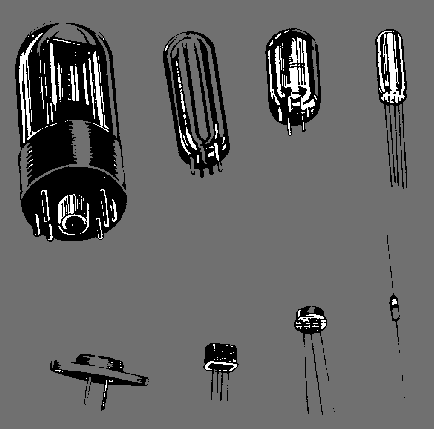
In the previous paragraphs, we mentioned just a few of the many different applications of semiconductor devices. The use of these devices has become so widespread that it would be impossible to list all their different applications. Instead, a broad coverage of their specific application is presented. Semiconductor devices are all around us. They can be found in just about every commercial product we touch, from the family car to the pocket calculator. Semiconductor devices are contained in television sets, portable radios, stereo equipment, and much more. Science and industry also rely heavily on semiconductor devices. Research laboratories use these devices in all sorts of electronic instruments to perform tests, measurements, and numerous other experimental tasks. Industrial control systems (such as those used to manufacture automobiles) and automatic telephone exchanges also use semiconductors. Even today heavy-duty versions of the solid-state rectifier diode are being use to convert large amounts of power for electric railroads. Of the many different applications for solid-state devices, space systems, computers, and data processing equipment are some of the largest consumers. The various types of modem military equipment are literally loaded with semiconductor devices. Many radars, communication, and airborne equipment are transistorized. Data display systems, data processing units, computers, and aircraft guidance-control assemblies are also good examples of electronic equipments that use semiconductor devices. All of the specific applications of semiconductor devices would make a long impressive list. The fact is, semiconductors are being used extensively in commercial products, industry, and the military. It should not be difficult to conclude, from what you already know, that semiconductor devices can and do perform all the conventional functions of rectification, amplification, oscillation, timing, switching, and sensing. Simply stated, these devices perform the same basic functions as the electron tube; but they perform more efficiently, economically, and for a longer period of time. Therefore, it should be no surprise to you to see these devices used in place of electron tubes. Keeping this in mind, we see that it is only natural and logical to compare semiconductor devices with electron tubes. Physically, semiconductor devices are much smaller than tubes. You can see in figure 1-1 that the difference is quite evident. This illustration shows some commonly used tube sizes alongside semiconductor devices of similar capabilities. The reduction in size can be as great as 100:1 by weight and 1000:1 by volume. It is easy to see that size reduction favors the semiconductor device. Therefore, whenever miniaturization is required or is convenient, transistors are favored over tubes. Bear in mind, however, that the extent of practical size reduction is a big factor; many things must be considered. Miniature electron tubes, for example, may be preferred in certain applications to transistors, thus keeping size reduction to a competitive area. Figure 1-1. - Size comparisons of electron tubes and semiconductors.
Power is also a two-sided story. For low-power applications, where efficiency is a significant factor, semiconductors have a decided advantage. This is true mainly because semiconductor devices perform very well with an extremely small amount of power; in addition, they require no filaments or heaters as in the case of the electron tube. For example, a computer operating with over 4000 solid-state devices may require no more than 20 watts of power. However, the same number of tubes would require several kilowatts of power. For high-power applications, it is a different story - tubes have the upper hand. The high-power tube has no equivalent in any semiconductor device. This is because a tube can be designed to operate with over a thousand volts applied to its plate whereas the maximum allowable voltage for a transistor is limited to about 200 volts (usually 50 volts or less). A tube can also handle thousands of watts of power. The maximum power output for transistor generally ranges from 30 milliwatts to slightly over 100 watts. When it comes to ruggedness and life expectancy, the tube is still in competition. Design and functional requirements usually dictate the choice of device. However, semiconductor devices are rugged and long-lived. They can be constructed to withstand extreme vibration and mechanical shock. They have been known to withstand impacts that would completely shatter an ordinary electron tube. Although some specially designed tubes render extensive service, the life expectancy of transistors is better than three to four times that of ordinary electronic tubes. There is no known failure mechanism (such as an open filament in a tube) to limit the semiconductor's life. However, semiconductor devices do have some limitations. They are usually affected more by temperature, humidity, and radiation than tubes are. Q.3 Name three of the largest users of semiconductor devices. |
|