Custom Search
|
|
  |
|
|
TRANSFORMER WINDINGS
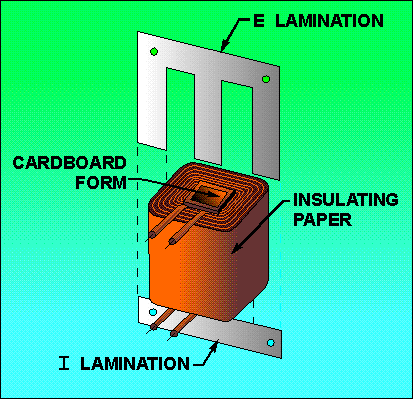
As stated above, the transformer consists of two coils called WINDINGS which are wrapped around a core. The transformer operates when a source of ac voltage is connected to one of the windings and a load device is connected to the other. The winding that is connected to the source is called the PRIMARY WINDING. The winding that is connected to the load is called the SECONDARY WINDING. (Note: In this chapter the terms "primary winding" and "primary" are used interchangeably; the term: "secondary winding" and "secondary" are also used interchangeably.) Figure 5-5 shows an exploded view of a shell-type transformer. The primary is wound in layers directly on a rectangular cardboard form. Figure 5-5. - Exploded view of shell-type transformer construction.
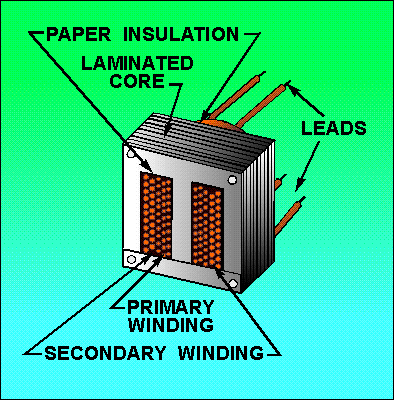
In the transformer shown in the cutaway view in figure 5-6, the primary consists of many turns of relatively small wire. The wire is coated with varnish so that each turn of the winding is insulated from every other turn. In a transformer designed for high-voltage applications, sheets of insulating material, such as paper, are placed between the layers of windings to provide additional insulation. Figure 5-6. - Cutaway view of shell-type core with windings.
When the primary winding is completely wound, it is wrapped in insulating paper or cloth. The secondary winding is then wound on top of the primary winding. After the secondary winding is complete, it too is covered with insulating paper. Next, the E and I sections of the iron core are inserted into and around the windings as shown. The leads from the windings are normally brought out through a hole in the enclosure of the transformer. Sometimes, terminals may be provided on the enclosure for connections to the windings. The figure shows four leads, two from the primary and two from the secondary. These leads are to be connected to the source and load, respectively. Q.5 Which transformer windings are connected to an ac source voltage and to a load,
respectively? |
 |
|
|
Integrated Publishing, Inc. - A (SDVOSB) Service Disabled Veteran Owned Small Business
|