Custom Search
|
|
  |
|
|
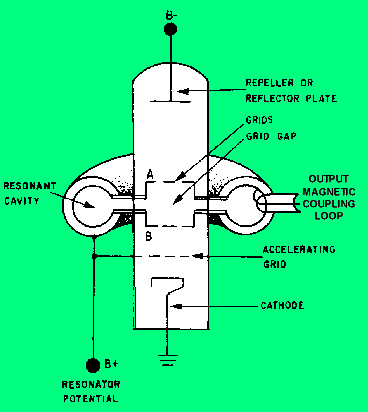
The Reflex Klystron Another tube based on velocity modulation, and used to generate microwave energy, is the REFLEX KLYSTRON (figure 2-9). The reflex klystron contains a REFLECTOR PLATE, referred to as the REPELLER, instead of the output cavity used in other types of klystrons. The electron beam is modulated as it was in the other types of klystrons by passing it through an oscillating resonant cavity, but here the similarity ends. The feedback required to maintain oscillations within the cavity is obtained by reversing the beam and sending it back through the cavity. The electrons in the beam are velocity-modulated before the beam passes through the cavity the second time and will give up the energy required to maintain oscillations. The electron beam is turned around by a negatively charged electrode that repels the beam. This negative element is the repeller mentioned earlier. This type of klystron oscillator is called a reflex klystron because of the reflex action of the electron beam. Figure 2-9. - Functional diagram of a reflex klystron.
Three power sources are required for reflex klystron operation: (1) filament power, (2) positive resonator voltage (often referred to as beam voltage) used to accelerate the electrons through the grid gap of the resonant cavity, and (3) negative repeller voltage used to turn the electron beam around. The electrons are focused into a beam by the electrostatic fields set up by the resonator potential (B+) in the body of the tube. Note in figure 2-9 that the resonator potential is common to the resonator cavity, the accelerating grid, and the entire body of the tube. The resonator potential also causes the resonant cavity to begin oscillating at its natural frequency when the tube is energized. These oscillations cause an electrostatic field across the grid gap of the cavity that changes direction at the frequency of the cavity. The changing electrostatic field affects the electrons in the beam as they pass through the grid gap. Some are accelerated and some are decelerated, depending upon the polarity of the electrostatic field as they pass through the gap. Figure 2-10, view (A), illustrates the three possible ways an electron can be affected as it passes through the gap (velocity increasing, decreasing, or remaining constant). Since the resonant cavity is oscillating, the grid potential is an alternating voltage that causes the electrostatic field between the grids to follow a sine-wave curve as shown in figure 2-10, view (B). As a result, the velocity of the electrons passing through the gap is affected uniformly as a function of that sine wave. The amount of velocity change is dependent on the strength and polarity of the grid voltage. Figure 2-10. - Electron bunching diagram.
The variation in grid voltage causes the electrons to enter the space between the grid and the repeller at various velocities. For example, in figure 2-10, views (A) and (B), the electrons at times 1 and 2 are speeded up as they pass through the grid. At time 3, the field is passing through zero and the electron is unaffected. At times 4 and 5, the grid field is reversed; the electrons give up energy because their velocity is reduced as they pass through the grids. The distance the electrons travel in the space separating the grid and the repeller depends upon their velocity. Those moving at slower velocities, such as the electron at time 4, move only a short distance from the grid before being affected by the repeller voltage. When this happens, the electron is forced by the repeller voltage to stop, reverse direction, and return toward the grid. The electrons moving at higher velocities travel further beyond the grid before reversing direction because they have greater momentum. If the repeller voltage is set at the correct value, the electrons will form a bunch around the constant-speed electrons. The electrons will then return to the grid gap at the instant the electrostatic field is at the correct polarity to cause maximum deceleration of the bunch. This action is also illustrated in figure 2-10, view (A). When the grid field provides maximum deceleration, the returning electrons release maximum energy to the grid field which is in phase with cavity current. Thus, the returning electrons supply the regenerative feedback required to maintain cavity oscillations. The constant-speed electrons must remain in the reflecting field space for a minimum time of 3/4 cycle of the grid field for maximum energy transfer. The period of time the electrons remain in the repeller field is determined by the amount of negative repeller voltage. The reflex klystron will continue to oscillate if the electrons remain in the repeller field longer than 3/4 cycle (as long as the electrons return to the grid gap when the field is of the proper polarity to decelerate the electrons). Figure 2-11 shows the effect of the repeller field on the electron bunch for 3/4 cycle and for 1 3/4 cycles. Although not shown in the figure, the constant-velocity electrons may remain in the repeller field for any number of cycles over the minimum 3/4 cycle. If the electrons remain in the field for longer than 3/4 cycle, the difference in electron transit time causes the tube performance characteristics to change. The differences in operating characteristics are identified by MODES OF OPERATION. Figure 2-11. - Bunching action of a reflex klystron.
The reflex klystron operates in a different mode for each additional cycle that the electrons remain in the repeller field. Mode 1 is obtained when the repeller voltage produces an electron transit time of 3/4 cycle. Additional modes follow in sequence. Mode 2 has an electron transit time of 1 3/4 cycles; mode 3 has an electron transit time of 2 3/4 cycles; etc. The physical design of the tube limits the number of modes possible in practical applications. A range of four modes of operation are normally available. The actual mode used (1 3/4 cycles through 4 3/4 cycles, 2 3/4 cycles through 6 3/4 cycles, etc.) depends upon the application. The choice of mode is determined by the difference in power available from each mode and the band of frequencies over which the circuit can be tuned. OUTPUT POWER. - The variation in output power for different modes of operation can be explained by examining the factors which limit the amplitude of oscillations. Power and amplitude limitations are caused by the DEBUNCHING process of the electrons in the repeller field space. Debunching is simply the spreading out of the electron bunches before they reach electrostatic fields across the cavity grid . The lower concentration of electrons in the returning bunches provides less power for delivery to the oscillating cavity. This reduced power from the bunches, in turn, reduces the amplitude of the cavity oscillations and causes a decrease in output power. In higher modes of operation the electron bunches are formed more slowly. They are more likely to be affected by debunching because of mutual repulsion between the negatively charged electrons. The long drift time in the higher modes allows more time for this electron interaction and, as a result, the effects of debunching are more severe. The mutual repulsion changes the relative velocity between the electrons in the bunches and causes the bunches to spread out. Figure 2-12 illustrates the ELECTRONIC TUNING (tuning by altering the repeller voltage) range and output power of a reflex klystron. Each mode has a center frequency of 3,000 megahertz which is predetermined by the physical size of the cavity. The output power increases as the repeller voltage is made more negative. This is because the transit time of the electron bunches is decreased. Figure 2-12. - Electronic tuning and output power of a reflex klystron.
Electronic tuning does not change the center frequency of the cavity, but does vary the frequency within the mode of operation. The amount the frequency can be varied above or below the center frequency is limited by the half-power points of the mode, as shown in figure 2-12. The center frequency can be changed by one of two methods One method, GRID-GAP TUNING, varies the cavity frequency by altering the distance between the grids to change the physical size of the cavity. This method varies the capacitance of the cavity by using a tuning screw to change the distance between the grids mechanically. The cavity can also be tuned by PADDLES or SLUGS that change the inductance of the cavity. Q.20 What element of the reflex klystron replaces the output cavity of a normal
klystron? |
 |
|
|
Integrated Publishing, Inc. - A (SDVOSB) Service Disabled Veteran Owned Small Business
|