Custom Search
|
|
  |
|||||||||||||||
|
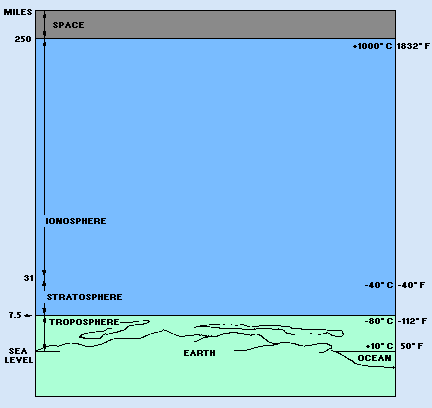
THE EFFECT OF THE EARTH'S ATMOSPHERE ON RADIO WAVES This discussion of electromagnetic wave propagation is concerned mainly with the properties and effects of the medium located between the transmitting antenna and the receiving antenna. While radio waves traveling in free space have little outside influence affecting them, radio waves traveling within the Earth's atmosphere are affected by varying conditions. The influence exerted on radio waves by the Earth's atmosphere adds many new factors to complicate what at first seems to be a relatively simple problem. These complications are because of a lack of uniformity within the Earth's atmosphere. Atmospheric conditions vary with changes in height, geographical location, and even with changes in time (day, night, season, year). A knowledge of the composition of the Earth's atmosphere is extremely important for understanding wave propagation. The Earth's atmosphere is divided into three separate regions, or layers. They are the TROPOSPHERE, the STRATOSPHERE, and the IONOSPHERE. The layers of the atmosphere are illustrated in figure 2-10. Figure 2-10. - Layers of the earth's atmosphere.
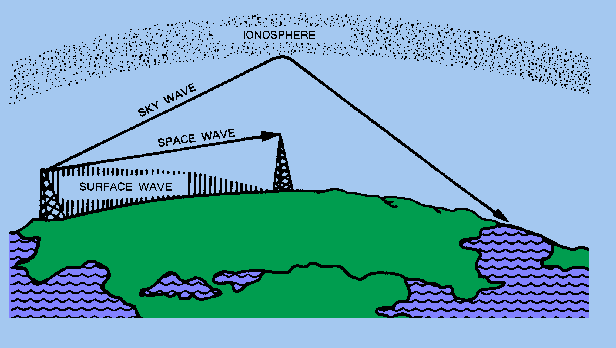
TROPOSPHERE The troposphere is the portion of the Earth's atmosphere that extends from the surface of the Earth to a height of about 3.7 miles (6 km) at the North Pole or the South Pole and 11.2 miles (18 km) at the equator. Virtually all weather phenomena take place in the troposphere. The temperature in this region decreases rapidly with altitude, clouds form, and there may be much turbulence because of variations in temperature, density, and pressure. These conditions have a great effect on the propagation of radio waves, which will be explained later in this chapter. STRATOSPHERE The stratosphere is located between the troposphere and the ionosphere. The temperature throughout this region is considered to be almost constant and there is little water vapor present. The stratosphere has relatively little effect on radio waves because it is a relatively calm region with little or no temperature changes. IONOSPHERE The ionosphere extends upward from about 31.1 miles (50 km) to a height of about 250 miles (402 km). It contains four cloud-like layers of electrically charged ions, which enable radio waves to be propagated to great distances around the Earth. This is the most important region of the atmosphere for long distance point-to-point communications. This region will be discussed in detail a little later in this chapter. Q.11 What are the three layers of the atmosphere? There are two principal ways in which electromagnetic (radio) energy travels from a transmitting antenna to a receiving antenna. One way is by GROUND WAVES and the other is by SKY WAVES. Ground waves are radio waves that travel near the surface of the Earth (surface and space waves). Sky waves are radio waves that are reflected back to Earth from the ionosphere. (See figure 2-11.) Figure 2-11. - Ground waves and sky waves.
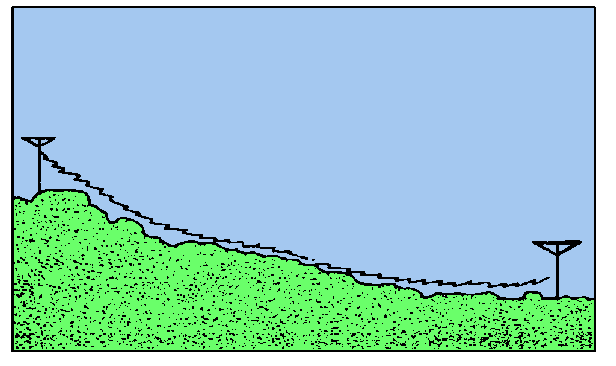
Ground Waves The ground wave is actually composed of two separate component waves. These are known as the SURFACE WAVE and the SPACE WAVE (fig. 2-11). The determining factor in whether a ground wave component is classified as a space wave or a surface wave is simple. A surface wave travels along the surface of the Earth. A space wave travels over the surface. SURFACE WAVE. - The surface wave reaches the receiving site by traveling along the surface of the ground as shown in figure 2-12. A surface wave can follow the contours of the Earth because of the process of diffraction. When a surface wave meets an object and the dimensions of the object do not exceed its wavelength, the wave tends to curve or bend around the object. The smaller the object, the more pronounced the diffractive action will be. Figure 2-12. - Surface wave propagation.
As a surface wave passes over the ground, the wave induces a voltage in the Earth. The induced voltage takes energy away from the surface wave, thereby weakening, or attenuating, the wave as it moves away from the transmitting antenna. To reduce the attenuation, the amount of induced voltage must be reduced. This is done by using vertically polarized waves that minimize the extent to which the electric field of the wave is in contact with the Earth. When a surface wave is horizontally polarized, the electric field of the wave is parallel with the surface of the Earth and, therefore, is constantly in contact with it. The wave is then completely attenuated within a short distance from the transmitting site. On the other hand, when the surface wave is vertically polarized, the electric field is vertical to the Earth and merely dips into and out of the Earth's surface. For this reason, vertical polarization is vastly superior to horizontal polarization for surface wave propagation. The attenuation that a surface wave undergoes because of induced voltage also depends on the electrical properties of the terrain over which the wave travels. The best type of surface is one that has good electrical conductivity. The better the conductivity, the less the attenuation. Table 2-2 gives the relative conductivity of various surfaces of the Earth. Table 2-2. - Surface Conductivity
Another major factor in the attenuation of surface waves is frequency. Recall from earlier discussions on wavelength that the higher the frequency of a radio wave, the shorter its wavelength will be. These high frequencies, with their shorter wavelengths, are not normally diffracted but are absorbed by the Earth at points relatively close to the transmitting site. You can assume, therefore, that as the frequency of a surface wave is increased, the more rapidly the surface wave will be absorbed, or attenuated, by the Earth. Because of this loss by attenuation, the surface wave is impractical for long-distance transmissions at frequencies above 2 megahertz. On the other hand, when the frequency of a surface wave is low enough to have a very long wavelength, the Earth appears to be very small, and diffraction is sufficient for propagation well beyond the horizon. In fact, by lowering the transmitting frequency into the very low frequency (vlf) range and using very high-powered transmitters, the surface wave can be propagated great distances. The Navy's extremely high-powered vlf transmitters are actually capable of transmitting surface wave signals around the Earth and can provide coverage to naval units operating anywhere at sea. SPACE WAVE. - The space wave follows two distinct paths from the transmitting antenna to the receiving antenna - one through the air directly to the receiving antenna, the other reflected from the ground to the receiving antenna. This is illustrated in figure 2-13. The primary path of the space wave is directly from the transmitting antenna to the receiving antenna. So, the receiving antenna must be located within the radio horizon of the transmitting antenna. Because space waves are refracted slightly, even when propagated through the troposphere, the radio horizon is actually about one-third farther than the line-of-sight or natural horizon. Figure 2-13. - Space wave propagation.
Although space waves suffer little ground attenuation, they nevertheless are susceptible to fading. This is because space waves actually follow two paths of different lengths (direct path and ground reflected path) to the receiving site and, therefore, may arrive in or out of phase. If these two component waves are received in phase, the result is a reinforced or stronger signal. Likewise, if they are received out of phase, they tend to cancel one another, which results in a weak or fading signal. Q.13 What is the determining factor in classifying whether a radio wave is a ground
wave or a space wave? |
|||||||||||||||
|
|
Integrated Publishing, Inc. - A (SDVOSB) Service Disabled Veteran Owned Small Business
|