Custom Search
|
|
  |
|
|
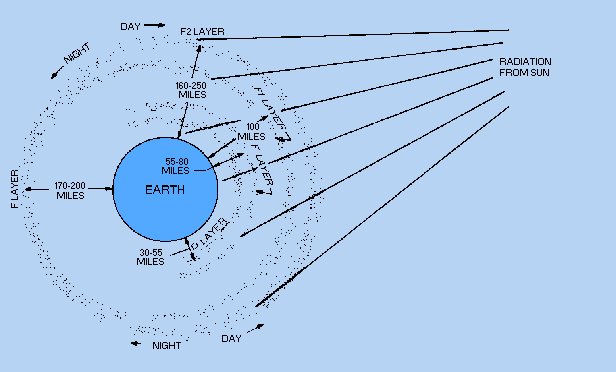
Sky Wave The sky wave, often called the ionospheric wave, is radiated in an upward direction and returned to Earth at some distant location because of refraction from the ionosphere. This form of propagation is relatively unaffected by the Earth's surface and can propagate signals over great distances. Usually the high frequency (hf) band is used for sky wave propagation. The following in-depth study of the ionosphere and its effect on sky waves will help you to better understand the nature of sky wave propagation. STRUCTURE OF THE IONOSPHERE As we stated earlier, the ionosphere is the region of the atmosphere that extends from about 30 miles above the surface of the Earth to about 250 miles. It is appropriately named the ionosphere because it consists of several layers of electrically charged gas atoms called ions. The ions are formed by a process called ionization. Ionization Ionization occurs when high energy ultraviolet light waves from the sun enter the ionospheric region of the atmosphere, strike a gas atom, and literally knock an electron free from its parent atom. A normal atom is electrically neutral since it contains both a positive proton in its nucleus and a negative orbiting electron. When the negative electron is knocked free from the atom, the atom becomes positively charged (called a positive ion) and remains in space along with the free electron, which is negatively charged. This process of upsetting electrical neutrality is known as IONIZATION. The free negative electrons subsequently absorb part of the ultraviolet energy, which initially freed them from their atoms. As the ultraviolet light wave continues to produce positive ions and negative electrons, its intensity decreases because of the absorption of energy by the free electrons, and an ionized layer is formed. The rate at which ionization occurs depends on the density of atoms in the atmosphere and the intensity of the ultraviolet light wave, which varies with the activity of the sun. Since the atmosphere is bombarded by ultraviolet light waves of different frequencies, several ionized layers are formed at different altitudes. Lower frequency ultraviolet waves penetrate the atmosphere the least; therefore, they produce ionized layers at the higher altitudes. Conversely, ultraviolet waves of higher frequencies penetrate deeper and produce layers at the lower altitudes. An important factor in determining the density of ionized layers is the elevation angle of the sun, which changes frequently. For this reason, the height and thickness of the ionized layers vary, depending on the time of day and even the season of the year. Recombination Recall that the process of ionization involves ultraviolet light waves knocking electrons free from their atoms. A reverse process called RECOMBINATION occurs when the free electrons and positive ions collide with each other. Since these collisions are inevitable, the positive ions return to their original neutral atom state. The recombination process also depends on the time of day. Between the hours of early morning and late afternoon, the rate of ionization exceeds the rate of recombination. During this period, the ionized layers reach their greatest density and exert maximum influence on radio waves. During the late afternoon and early evening hours, however, the rate of recombination exceeds the rate of ionization, and the density of the ionized layers begins to decrease. Throughout the night, density continues to decrease, reaching a low point just before sunrise. Four Distinct Layers The ionosphere is composed of three layers designated D, E, and F, from lowest level to highest level as shown in figure 2-14. The F layer is further divided into two layers designated F1 (the lower layer) and F2 (the higher layer). The presence or absence of these layers in the ionosphere and their height above the Earth varies with the position of the sun. At high noon, radiation in the ionosphere directly above a given point is greatest. At night it is minimum. When the radiation is removed, many of the particles that were ionized recombine. The time interval between these conditions finds the position and number of the ionized layers within the ionosphere changing. Since the position of the sun varies daily, monthly, and yearly, with respect to a specified point on Earth, the exact position and number of layers present are extremely difficult to determine. However, the following general statements can be made: Figure 2-14. - Layers of the ionosphere.
1. The D layer ranges from about 30 to 55 miles. Ionization in the D layer is low because it is the lowest region of the ionosphere. This layer has the ability to refract signals of low frequencies. High frequencies pass right through it and are attenuated. After sunset, the D layer disappears because of the rapid recombination of ions. 2. The E layer limits are from about 55 to 90 miles. This layer is also known as the Kennelly-Heaviside layer, because these two men were the first to propose its existence. The rate of ionic recombination in this layer is rather rapid after sunset and the layer is almost gone by midnight. This layer has the ability to refract signals as high as 20 megahertz. For this reason, it is valuable for communications in ranges up to about 1500 miles. 3. The F layer exists from about 90 to 240 miles. During the daylight hours, the F layer separates into two layers, the F1 and F2 layers. The ionization level in these layers is quite high and varies widely during the day. At noon, this portion of the atmosphere is closest to the sun and the degree of ionization is maximum. Since the atmosphere is rarefied at these heights, recombination occurs slowly after sunset. Therefore, a fairly constant ionized layer is always present. The F layers are responsible for high-frequency, long distance transmission. Q.17 What causes ionization to occur in the ionosphere? |
|
|
|
Integrated Publishing, Inc. - A (SDVOSB) Service Disabled Veteran Owned Small Business
|