Order this information in Print

Order this information on CD-ROM

Download in PDF Format


Click here to make tpub.com your Home Page

Page Title: Chapter 11 - Extensions on Diatonic Chords
Back | Up | Next

tpub.com Updates

Google


Web
www.tpub.com

Home

   
Information Categories
.... Administration
Advancement
Aerographer
Automotive
Aviation
Combat
Construction
Diving
Draftsman
Engineering
Electronics
Food and Cooking
Math
Medical
Music
Nuclear Fundamentals
Photography
Religion
USMC
   
Products
  Educational CD-ROM's
Printed Manuals
Downloadable Books


Back
Tonic Seventh
Up
Harmony for Musicians
Next
Minor Ninth

Back ] Home ] Up ] Next ]

CHAPTER 11
Extensions on Diatonic Chords
Extended Chords are discussed in Basic Music (TC 12-41\ NAVEDTRA 10244). These chords contain five or more pitches, which requires a selection of notes for four parts. Chords with extensions appear primarily in root position. An extension may be analyzed as an essential harmonic tone or as an unessential non-harmonic tone (appoggiatura or accented passing tone). Extensions appear primarily in the soprano voice.

MAJOR NINTH
Major ninths appear in major keys on the dominant seventh or supersonic seventh chord. Normally, the fifth of the chord is omitted.

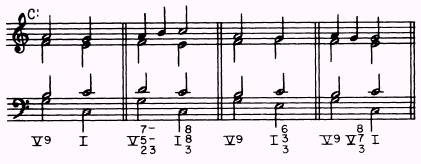
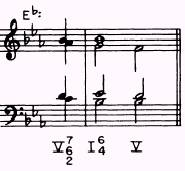
The major ninth on a dominant seventh resolves down by step to the root of the dominant seventh (appoggiatura) or to the fifth of the tonic at the change of chord. The third of the dominant seventh is occasionally omitted and the ninth functions as an upward resolving appoggiatura to the third. Figuring for chords in root position with a ninth is the single numeral 9.

FIGURE 11.1. The Major Ninth in Root Position
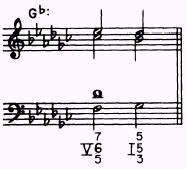
The dominant ninth may appear in inversion. Figuring for inversion is:
for first inversion.

FIGURE 11.2. First Inversion of the Major Ninth

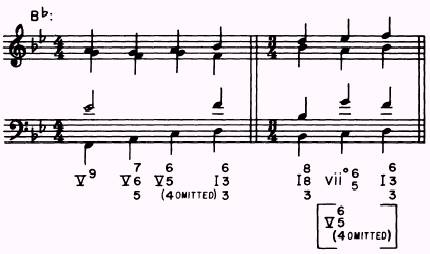
for second inversion. The second inversion of the dominant ninth chord is better analyzed (4 omitted) as vii .

FIGURE 11.3. Second Inversion of the Major Ninth

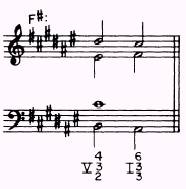
for third inversion.

FIGURE 11.4. Third Inversion of the Major Ninth

for fourth inversion (rare) resolving to a I .


FIGURE 11.5. Fourth Inversion of the Major Ninth
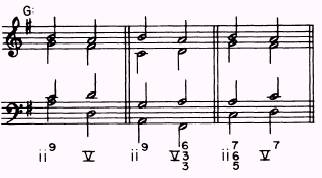
The major ninth on a supersonic seventh resolves down by step: to the root of the supersonic chord (appoggiatura), to the fifth of the dominant chord (supersonic), or to the third of the leading tone chord (supersonic). An interval of a major seventh exists between the third and ninth of this chord. The third and ninth should not be voiced in adjacent voices when they form a minor second. The supersonic ninth may occasionally appear in the first inversion

FIGURE 11.6. The Major Ninth on the Supersonic Seventh

Back ] Home ] Up ] Next ]

This information is now available on CD in Adobe PDF Printable Format


Privacy Statement - Press Release - Copyright Information. - Contact Us - Support Integrated Publishing