Custom Search
|
|
 
|
||
|
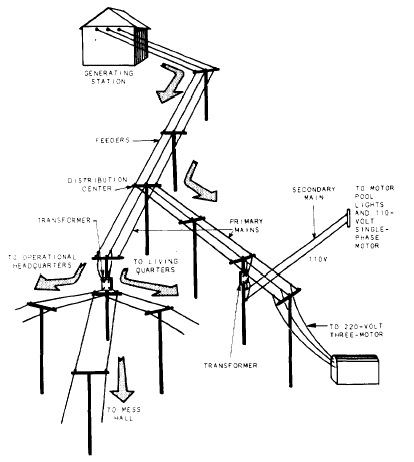
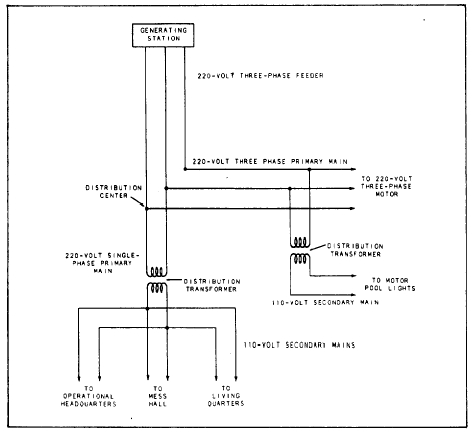
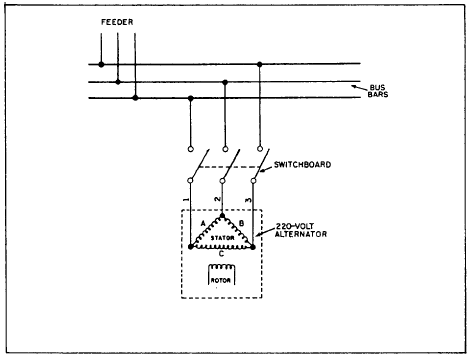
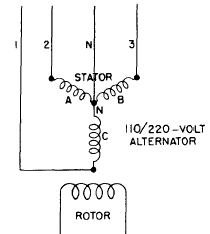
Overhead Power Distribution Figure 9-2 shows a three-phase, three-wire OVERHEAD power distribution system. Assume that the system has an alternator generating 220 V (fig. 9-3). From the generating station, three-phase, three-wire feeders carry the power overhead to the distribution points (or centers), from which two primary mains branch off. One of these mains carries power to a lighting system and a single-phase motor in a motor pool, each of which is designed to operate on 110 V, and to a three-phase motor designed to operate on 220 V. The 220-V, three-phase motor is connected directly to the 220-V, three-phase primary main. However, for the lighting system and 110-V motor, two wires in the primary main are tapped off to a transformer, which reduces the 220-V primary main voltage to 110 V. The use of two wires creates a single-phase voltage in the secondary main to the motor pool. Similarly, power to secondary mains running to the operational headquarters, living quarters, and the mess hall is reduced to 110 V and converted to single phase.A system may be a THREE-WIRE or a FOUR-WIRE system, depending upon whether the alternators are connected DELTA (A) or WYE (Y). Figure 9-4 is a schematic diagram showing a delta connection. The coil marked
Figure 9-2.-A typical overhead power distribution system.
Figure 9-3.-Wiring diagram of the three-phase, three-wire distribution system in figure 9-2.
Figure 9-4.-Schematic diagram of a delta-connected alternator.
Figure 9-5.-Y-connected alternator (three-phase, four-wire). STATOR represents the stationary coils of wire in the alternator; the one marked ROTOR represents the coils, which rotate on the armature. You can see that the power is taken off the stator from three connections, which in the drawing form a triangle or delta. All three wires are live (called HOT) wires. |
||
|
||