Custom Search
|
|
 
|
||
|
Occipital Bone The occipital bone forms the back part of the skull and the base of the cranium. It joins with the parietal and temporal bones. In the center, underside (inferior) portion of the cranium, there is a large opening called the foramen magnum (fig. 3-5), through which nerve fibers from the brain pass and enter into the spinal cord.
Figure 3-4.\Temporal bone.
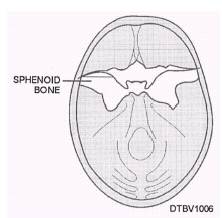
Figure 3-5.\Foramen magnum of cranial cavity viewed from above. The occipital bone is an irregular, four-sided bone that is somewhat curved upon itself. Sphenoid Bone The sphenoid bone has a wing-like shape and is internally wedged between several other bones in the front part of the cranium (fig. 3-6). This bone assists with the formation of the base of the cranium, the sides of the skull, and the floors and sides of the orbits.
Figure 3-6.\Sphenoid bone viewed from above. Ethmoid Bone The ethmoid bone is situated in front of the sphenoid bone in the front part of the cranium (fig. 3-7). Through small openings in this bone pass nerves to the roof of the mouth that are responsible for sense of smell. |
||
|
||