|
||
|
|
||
|
Page Title:
Conditions favorable for advection radiation fog |
||
| |||||||||||||||
|
|
Click here to Order your Radar Equipment Online CONDITIONS FAVORABLE FOR ADVECTION-RADIATION FOGCold and moist are apt descriptions of air masses that form in the late summer and early fall in the western quadrants of the Bermuda High. Cyclogenesis off the east coast of the United States, as well as the southerly flow associated with continental polar highs that have moved out over the ocean, are also cold and moist. If
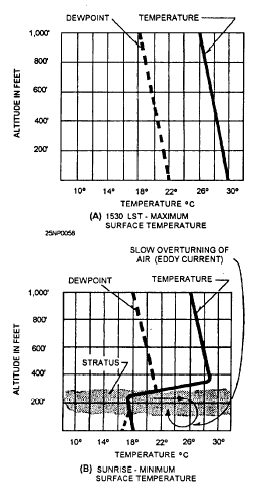
Figure 5-16.-Nocturnal cooling over a land area producing stratus (10- to 15-knot wind). (A) 1530 local maximum surface temperature; (B) sunrise-minimum surface temperature.this air mass moves inland (replacing warm, dry, land air), it may be cooled to saturation due to radiational cooling during the long autumn nights with consequent formation of fog or stratus. The fog is limited to the coastal areas, extending inland between 150 and 250 miles, depending on the wind speed. On the east coast, it is limited to the region between the Appalachian Mountains and the Atlantic Ocean.
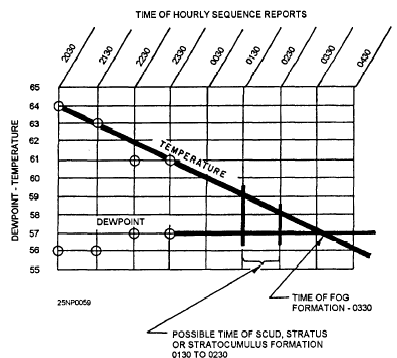
Figure 5-17.-Saturation time chart. (0s indicate actual temperature and dewpoint observations. Straight line is forecast temperature-dewpoint trends.)In late fall and winter, when continental temperature gradients have intensified, and the land temperature has become colder than the adjacent water, poleward moving air is cooled by advection over colder ground, as well as by radiation. If the air is sufficiently moist, fog or stratus may form. During daytime, heating may dissipate the fog or stratus entirely. If not, the heating, together with the wind, which is advecting the air, sets up a turbulence inversion and stratus or stratocumulus layers form at the base of the inversion. At night if the air is cooled again and the surface pressure gradient is weak, a surface inversion may replace the turbulence inversion, and fog again occurs at the surface. However, if the pressure gradient is strong, cooling will intensify the inversion. Under these conditions stratus or stratocumulus clouds occur just as in the daytime, except with lower cloud bases.Late fall and winter advection-radiation fogs cart occur any place over the continent that can be reached by maritime air or modified returning continental air. Mainly, this occurs over the eastern half of the United States. However, since tropical air masses do not reach as high a latitude in winter as in summer, the frequency of such fogs are much less in the northern regions of the country. With large, slow-moving, continental warm highs over the eastern half of the country, however, the fogs may extend all the way from the Gulf of Mexico to Canada.This information is now available on CD in Adobe PDF Printable Format |
|
Privacy Statement - Press Release - Copyright Information. - Contact Us - Support Integrated Publishing |