Custom Search
|
|
 
|
||
|
One of the most difficult tasks in photographing people is directing them. But you, the photographer, are the only one that can actually see what the picture is going to look like before it is taken. So, you must take the responsibility for setting up the pose. It is not enough to let your subjects just arrange themselves. They have no idea what they look like. One way to make directing and posing easier is to give your subject something to do. Do not tell your subject to "just stand there," as though in a vacuum, with nothing to do. Instead, give your subject something to handle. For a man, it might be a pipe, a book, a spyglass, or a tool they use in their work. For a child, it could be a doll, a model plane, or something of a similar nature. Often a woman can use an item of clothing in this way-a hat or a scarf. Another useful tip is to give your subject a prop or a support in a more literal sense-something to lean on or sit on. A chair, stool, post, or tree can be used. When using props, frames, and poses, do not forget one important point: The Navy uses photographers so its pictures are made by professionals. These are people who know what they are photographing and the reason why. A civilian photographer could most probably make an excellent picture of a Navy scene; however, it probably will show technical errors that make the picture look like a joke to other sailors. Do a little research. If using props that you do not understand, ask about them. Do not have a sailor hauling on a line that should be taken to a capstan or a Gunner's Mate holding a 3-inch shell in front of a 5-inch gun. Eyes are very important when photographing people. You must direct the subject to ensure that all parts of the scene are in the right place or in proper perspective. You must also direct the expression of the subject. The eyes are a very vital part of this and have a significant effect on the viewer's response. In a picture where the eyes of the subject are looking straight into the camera, a strong and immediate impact is created. This attracts viewer interest. When the eyes are directed away from the camera, the effect is less explicit and has a more ambiguous quality. Finally, you must be in charge of the situation. It is up to you to tell the subjects where to stand, what to do, how to do it, and when to do it. This applies to everyone.
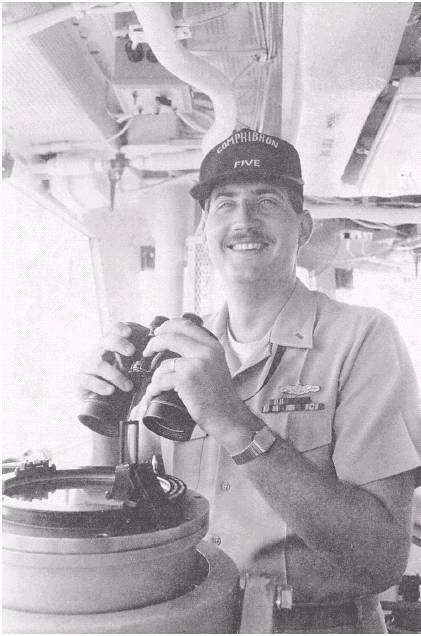
PHC Chet King 302.272 Figure 6-1A. LT(jg) Robin T. Russler stands watch on the flag bridge of the USS Tripoli. Do not fear the brass. They need directing too; after all, you are the professional and that is why they hired you-to do your job and to produce the best possible pictures of them. Many people are nervous and self-conscious in front of a camera. They try to look their best, and in so doing often present an expression or pose that is unnatural and displeasing. You are obligated to provide directions to the subjects regarding their pose. As the photographer, it is your responsibility to ensure that coat sleeves are pulled down, wrinkles smoothed out, hat set at the proper angle, body erect, head tilted at the best angle, and a dozen other things which, if not corrected, detract from the picture. Whether the subject is a seaman or an admiral, the photographer must observe these discrepancies and correct them. Figure 6-1A and figure 6-1B present examples of pictures of people in their environment.
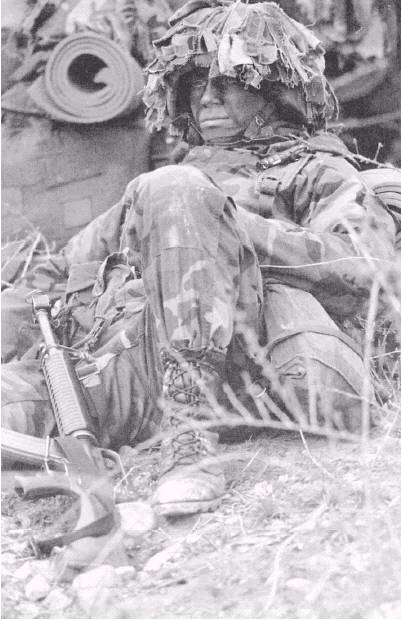
JO1 Joe Lancaster 302.273 Figure 6-1B. A member of the Army's 7th Infantry Division takes a break during the combined South Korean and U.S. exercise Team Spirit 1990. One of the greatest contributing factors to poor pictures is the timid manner in which a novice photographer handles the subject. Never take a picture when something is wrong because you are afraid to speak and act in the presence of high-ranking personnel. The results will surely be disappointing and embarrassing; however, you should always be courteous and respectful in dealing with your subjects regardless of rank or rate. |
 |
|
|
||