Custom Search
|
|
 
|
||
|
The Navy Visual Information Management and Operations Manual, OPNAVINST 5290.1 (series), governs the administration and operation of Navy imaging facilities. It outlines the organization and administration of audiovisual units and provides policies and instructions for the use of imaging products in the Navy. You should consult this manual for the most current information concerning the organization of naval imaging. The ability to track photographic jobs within your facility quickly and accurately depends on the job control system of your imaging facility. When the system is not used correctly, photographic requests, negatives, prints, and other requirements may be lost or misplaced. This causes an inordinate delay in customer service that has a negative impact on your relationship with other divisions. JOB-ORDER LOG An unclassified job-order log is maintained by all imaging facilities. The log must contain, as a minimum, the following information: sequential job order numbers, security classification, product identification, and disposition of the work request (person who picked up the job). Additional data required by your imaging facility, such as date and requester, may also be included in the job-order log. Unclassified identifiers are used to refer to classified subjects. A separate job-order log is maintained for classified work requests. Job order logs are created on the first day of each fiscal year, and the job order number is reset to 000001. The fiscal year of the federal government runs from 1 October to 30 September.
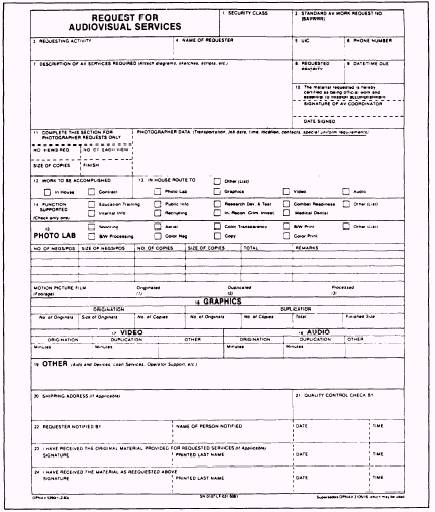
Figure 14-2A. OPNAV 5290/1 (Front). VISUAL INFORMATION JOB-ORDER FORM ALL work performed by Navy imaging facilities must be documented on a job-order form. The job-order form is used to maintain close control of in phases of imaging services. The job-order form serves several purposes; they are as follows: as an official request for visual information (VI) services, as the authority to perform the work, as a record of the time and materials used to complete the job, and as a receipt for the finished work. Navy imaging facilities may use the Request for Audiovisual Services, OPNAV 5290/1 (fig. 14-2A), or a locally created, in-house job-order form. As a minimum, an in-house job-order form must contain the following information: a job-order number, a customer signature block with a disclaimer that the service requested is official work and essential to mission accomplishment, product security classification, and any other information required by your facility to accomplish the request officially.
Figure 14-2A is an example of an Request for Audiovisual Services, OPNAV 5290/1. Figure 14-2A shows the front side of the form. The front side can be broken down into two sections. The top section, Blocks 1 through 14, may be completed by the requester or a person assigned to the job-control desk by the imaging facility. The completion of these blocks is self-explanatory. Block 2 (the work request number) is the
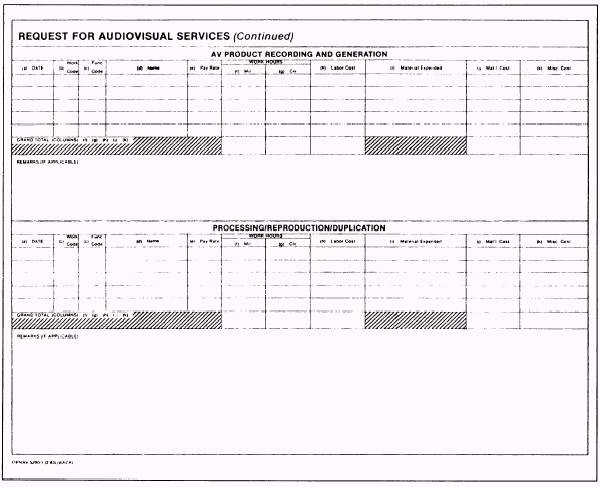
Figure 14-2B. OPNA V 5290/1 (Back). next sequential job-order number taken from the job-order log. Block 7 (description of services required) is the most important block on the front side. This block must describe the requirements of the requester completely. There are times when you must ask the requester specifically what is desired to meet the necessary requirements. The information provided in this block must indicate the time, equipment, and number of personnel required to complete the assignment. Sketches, diagrams, or other additional information may be attached. Blocks 15, 16, and 17 indicate the quantities of materials needed by the requester. The Remarks block may be used to indicate whether the original film or videotape should be provided to the requester, the file, or be forwarded to an imaging records center. The back of OPNAV 5290/1 (fig. 14-2B) is divided into two sections. The top half is used to document the production of original materials. The bottom half is used to record processing, reproduction, and duplication. When completing these sections of the job order, you must provide accurate details. The data in these sections are used to justify budget requests for the money and personnel required to provide imaging services by the imaging facility. NOTE: When assigned to the job-control area, you must be sharp and professional. The image that you portray reflects the professionalism of your entire imaging facility. Most customers never see the production spaces. It is your attitude and appearance that leaves a lasting impression on your customers. |
 |
|
|
||