Custom Search
|
|
 
|
||
|
The performance of videotape is often directly related to the care and proper maintenance it has or has not received. Temperature extremes should be avoided when storing tape between recording and playback. Wide temperature variations can result in a tremendous amount of stress on the innermost tape layers caused by dimensional changes. If a tape has been in storage at sub-zero temperatures, for example, you must
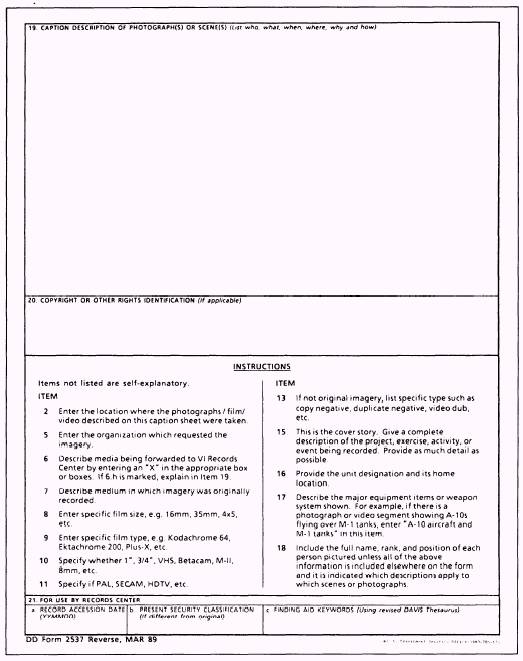
Figure 13-18B. Visual information caption sheet (back). condition it to room temperature. Complete dimensional equilibrium may take as much as about 16 hours. Never use direct heat to speed up the conditioning process. High temperatures can create harmful differences in layer-to-layer tension on the reel. Never use extreme cold, such as a freezer, to cool down a hot tape. In general, recommended storage conditions for videotapes are as follows: Relative Humidity . . . . . 50% - 60% Temperature . . . . . . . . 60F - 80F For best long-term storage, rewind video cassettes uniformly for even tension before boxing. Tapes should always be in one of two places-in the VTR or in the original box. Stand videotape boxes upright. Do not store tapes in a horizontal position. This can cause bending and distorting of reel flanges that can be a major cause of tape edge damage. To prevent damage, you should protect videotapes by covering them when they are not in use. Keeping them in dustproof cassette containers prevents the accumulation of airborne dust on the tapes. Dust can be a prime cause of dropout. Body oils and salts from your fingertips can pick up and hold foreign particles that, when transferred to the tape, cause dropouts. |
 |
|
|
||