Custom Search
|
|
 
|
||
|
The slate you use to identify video scenes may take several forms. In emergencies you may even write scene identification on a scrap of paper and film it before shooting the scene; however, in most instances, your slate is more formal. Your regular slate is made to show whatever information is necessary. Generally, this includes the command or unit, title or subject, name of the cameraperson (identifies who is responsible for filming or videotaping the good or bad footage), date, location, and camera serial number (fig. 13-16). If you are part of a large organization that has several crews, then also include the unit number. In short, the slate should contain information needed for proper identification of each scene on your film. The slate may actually be a piece of slate with the data written or lettered on it in white chalk. Quite often the slate is white with an acetate surface, and the data is written on it with a black grease pencil. When you slate a scene, hold the slate in front of the camera lens and record it for about 10 seconds for videotape or 3 feet for motion-picture film. Of the information you place on your slate should be clearly printed in large, block letters. Film your slate so it fills the complete frame. If your slate is not full frame, the lettering may be too small to read when the tape is viewed.
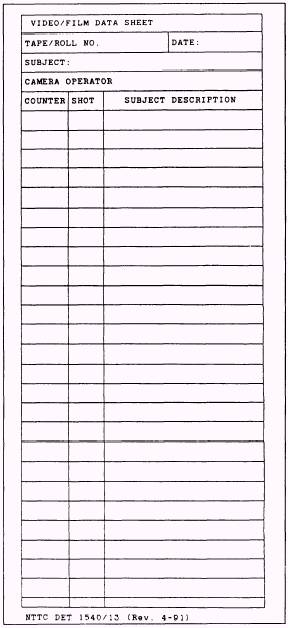
Figure 13-17. Video/Film Data Sheet. If you do not have time to film the slate at the beginning of the scene, do it at the end of the scene. This is known as tail slating. Record the slate upside down, then rotate it right side up when tail slating. This shows that a tail slate was used; otherwise, the viewer might assume that it is associated with the scene following it on the tape. When recording without a script, you have no scene numbers to slate for each scene; therefore, for identification purposes, you slate only at the beginning of each tape. If for some reason you cannot slate at the beginning, tail slating applies. Although you, the camera operator, do not derive any particular value from the slate, the person editing your film becomes frustrated, if not completely lost, when slates are not included. This is particularly true when your scenes are not shot in the same order as the script is written. The task of locating individual shots is almost impossible unless each scene is slated when it is originally filmed. You can understand now why you must slate each scene when shooting from a script. |
 |
|
|
||