Custom Search
|
|
 
|
||
|
Videotaping is similar to audiotape recording. The electronic impulses of television pictures (video signal) and sound (audio signal) are recorded on the videotape by magnetizing the iron oxide coating on the videotape. During playback, the recorded video and audio signals are converted again by the television set into television pictures and sounds. However, the amount of electronic information is many times greater for video than for audio recording. RECORDING SYSTEMS There are many different systems of treating and recording the video signals. Videotape recording systems can be divided roughly into three subsections: analog and digital; composite (Y/C), and component; and tape formats. Analog and Digital Systems Both analog and digital systems are used in naval imaging facilities. The analog system is easier to understand if you think of it in the same terms as a record and a phonograph. Analog systems record the continually fluctuating video signal that is created and processed by a video source (camera) on videotape. During playback, the recorded information is retrieved as an identical, continually fluctuating signal from the videotape. Digital-video systems work on the same principle as compact disks (CD) used in your home stereo or office computer. Digital-video systems convert the analog video signals by sampling (selecting parts of) the scanned image. It then translates the scanned image into millions of independent, fixed, values called pixels. A pixel is the smallest single picture element from which images are constructed. Each pixel has its own color (hue and saturation) and luminance values. These values are expressed as binary numbers (series of zeros and ones). The binary numbers are then stored on, and retrieved from, videotape or other storage mediums, such as large-capacity disks. Composite (Y/C) and Component Composite (Y/C) and component all refer to the way the video signal is treated in the videotape recorder. A composite video signal means that the luminance information ( Y signal), chrominance information ( C signal), and the sync information are combined into a single signal (Y+C+sync). Standard television information is designed to operate with composite video signals. Only one wire is required to transport a composite video signal. This composite signal is usually called NTSC, because the electronic specifications for a composite video signal were adopted by the National Television Standards Committee. The major disadvantage of a composite signal is that slight interference exists between the chrominace and luminance information. This interference becomes more noticeable through each videotape generation. In a true component system, the R, G, B channels are kept separate and treated as separate red, green, and blue video signals throughout the entire recording process. Each of the three signals remains separate even when laid down on the videotape. The component system requires three wires to transport a video signal. This means that all equipment used in the component system requires three wires to handle the video signal that is incompatible with the NTSC system. When the video is going to be televised, the signals of the Y/C and component systems must be combined into a single NTSC composite signal before it can be broadcast.
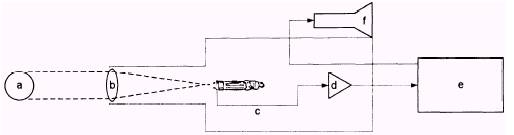
Figure 13-3. Basic principles of a motion-video camera. Tape Format Systems The classification of a videotape recorder VTR by tape width was particularly important in the earlier days when the quality of the videotape recording was directly related to the tape format. The old standard used to be, the wider the tape, the higher the quality of the recording. Anything smaller than the l-inch videotape was considered small format and inferior in quality. Today, 1/2-inch Betacam SP can provide equal or superior quality compared to the large-format, l-inch machines. The Hi8 video camera (8mm) is superior to the 1/2-inch VHS cameras. Today, small format is used mainly to describe small, highly portable television equipment, such as small camcorders. Like all state-of-the-art electronic equipment, smaller no longer implies inferior quality. The quality of the tape itself has much to do with the quality of the picture. No matter how sophisticated the video hardware, the resulting picture is only as good as the videotape being used. Videotape is a ribbon of polyester film base coated with magnetic iron-oxide particles. The surface of the tape, or emulsion side, that faces the video recorder heads is highly polished to maximize tape-to-head contact and to minimize wear on the heads. Head clogging results when oxide comes off the tape and gets caught in the head gaps of the recorder. If the tape clogs the video recording heads, you cannot play back or record. Normally, the heads will clog after recording or playing back half a dozen or so tapes. You should have the heads cleaned according to the manufacturer's recommendations or according to Planned Maintenance System (PMS) requirements. Videotape dropout occurs when a piece of magnetic oxide or coating on the tape flakes off or is rough, causing a hole or line of missing information in the picture when it is viewed on the monitor. Dropout appears on the TV screen as little black or white lines, darting across the picture. The main causes of dropout are dirty heads or imperfections in the tape. Once dropout occurs, it cannot be replaced or corrected on the tape. There are no black-and-white or color videotapes. Any videotape will record either black and white or color. Black and white or color depends solely on whether the camera and monitor are black and white or color. |
 |
|
|
||