Custom Search
|
|
 
|
||
|
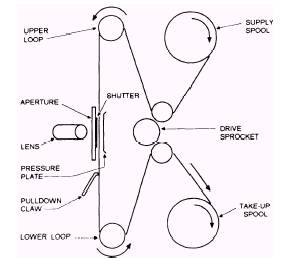
- MOTION MEDIA Motion media has gone through many technical advances in the past several years. Portable motion-video cameras have changed from cumbersome cameras and recording packs to small hand-held cameras. Reduced size, improved quality, and easier operation has, and is continuing to improve and expand motion video in all areas of the Department of Defense. Most Navy ships have closed circuit television systems for information, entertainment, and educational purposes. Motion media is distributed easily and dominates all other sources of communication in today's society. Because of this, the Navy uses this form of communication extensively to relay information. The most common form of motion-media photography is video. Since the motion picture is the grand-father to the technology of motion media as we know it today, it is discussed briefly in this chapter. MOTION PICTURE The first fact regarding motion pictures is they do not move. Each image or frame of motion picture film is a separate, still photograph. These individual images or frames are normally recorded at a rate of 24 separate pictures per second. This rate can be varied to achieve certain effects. Since so little time passes between exposing one frame and the next, there is relatively little difference between pictures, even when the subject moves rapidly. The illusion of motion in motion-picture photography is due to the natural characteristic of human vision. This characteristic of human vision is called persistence of vision. Persistence of vision was discovered by Peter Mark Roget, the author of the famous Thesaurus. The retina of the eye continues to perceive an image for a short period of time after the light stimulus representing the image has been removed. Usually, this after image lasts about 1/50 second, depending on the brightness of the image. In viewing a motion picture, the eye continues to perceive the fading image projected from one frame as it is replaced by the next frame, and so on. In effect, the images are momentarily superimposed in our vision, so any differences between them, however slight, are mentally noted. If these differences suggest any relative change in subject position, the apparent difference is mentally interpreted as motion. The mind translates this information into the logical deduction that whatever we are seeing on the movie screen must be moving. CAMERAS Since motion pictures are a series of still pictures, the motion-picture camera is basically the same as the still-picture camera. The primary difference is that it has a mechanism for taking a series of many photographs in rapid succession and at regular intervals on a ribbon of film. All cameras have the following four basic parts: a lighttight compartment, a lens or lenses, a shutter, and a film plane or pressure plate. The motion-picture camera has two additional basic features; the film drive and intermittent action. The film drive mechanism transports the film continually from a supply spool of unexposed film to a take-up spool of exposed film. This transport takes place by means of toothed, drive sprockets. The teeth of the drive sprockets engage the perforations along the edge of the film and move the film through the camera. The intermittent action in a motion-picture camera is caused by a pulldown claw that advanced the film one frame at a time at the film gate. During one cycle of operation of a motion-picture camera, the following action takes place. The film is advanced by the sprocket drive mechanism. The pulldown claw or shuttle then advances the film one frame. The film is stopped momentarily and the shutter revolves once, thereby making the exposure. The pulldown claw then moves the film to the next frame for exposure. Because the film moves in an intermittent or stop-and-go manner, it becomes necessary to have a surplus or loops of film before and after the pulldown claw to help take up the
Figure 13-1. Basic components of a motion-picture camera.
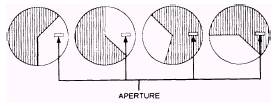
Figure 13-2. Rotary shutter. shock and prevent the film from breaking (fig. 13-1). The shutter in most motion-picture cameras is a focal plane type and is called a rotary disk shutter. A rotary disk shutter is a disk that has a segment cut out, causing the shutter to have a light and dark cycle as it rotates. Exposure is made when the cutout segment of the shutter passes in front of the film. The film is advanced during the dark cycle (fig. 13-2). A motion-picture camera is used to photograph action in a rapid succession of still pictures on a long strip of film. Each picture area on a motion-picture film is called a frame, and the speed that the camera is operated is called frames per second (fps). The standard operating speed for 16mm cameras is 24 fps. When the camera operating speed and the rate of projection are the same, the action looks normal; therefore, the standard projection speed is also 24 fps. However, it is possible, and sometimes desirable, to make motion pictures at a slower or faster rate than 24 fps. You may do this to either slow down or speed up the action on the screen. To portray a subject in slow motion, you operate the camera at a speed faster than the standard 24 fps, but keep the projector at the standard speed. To portray a subject in fast motion, you operate the camera at a speed slower than 24 fps, and the film is projected at 24 fps. All changes to the portrayal of normal subject motion should be done by adjusting the camera speed, not the movie projector. Camera speeds in the thousands of frames per second are used in scientific and experimental research to measure and observe such things as the fall of liquids, the speed of objects in flight, and the bursting characteristics of objects. When films shot at very fast fps rates are projected at 24 fps, the illusion of subject motion on the screen is slowed down considerably. At these speeds the viewer can study details of the subject matter and obtain research data. Motion-picture cameras are classified according to the size (width) of the film they use. The most common motion-picture film sizes are as follows: 8mm, super 8, 16mm, and 35mm. In the Navy today, motion-picture film has almost been completely replaced with video film; however, Hollywood productions still use motion-picture film as large as 70mm. Lenses used in motion pictures are basically the same as lenses for still photography; therefore, the information on optics presented in chapter 1 also applies to motion-picture camera lenses. The standard or normal focal length lens for a 16mm camera is 1 inch (25mm). Longer or shorter focal length lenses should be considered as long focal length (telephoto) or wide-angle lenses, respectively, depending on what size film is used. A long focal length lens for 16mm film is 38mm or longer. A wide-angle focal length lens for this camera is 13mm-17mm. Table 13-1 illustrates some typical camera and lens combinations. FILTERS With one exception, the use of filters for motion pictures is the same as for still photography. The effects that filters produce on motion-picture film emulsions are the same as the effects they produce on still photographic film emulsions. The one exception is the use of a polarizing filter. Camera panning should be avoided because variable darkening of the image results. The information on filters presented in chapter 3 applies to motion-picture photography as well as still photography.
Figure 13-1. Camera Sizes and Lens F-1 Lengths
|
 |
|
|
||