Custom Search
|
|
 
|
||
|
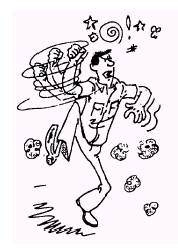
MEETING CUSTOMER NEEDS In the preceding chapter we presented various case studies to help you analyze the effects of your actions as a contact point representative. These analyses were intended to help you see yourself from the customers' point of view and to help you answer the question, Am I providing good service? In most of the case studies, when the customers began seeking help, they were in a good mood, had trust in the ability of the contact representative, and were willing to accept the representative's solution. In reality, that is not always the case. Trying to meet a customer's needs involves several obstacles: coping with a negative attitude, maintaining self-control, determining the specific cause of the problem, and identifying contributing causes. These obstacles can complicate the customer's problem and your efforts to provide a solution. Coping With a Negative Attitude Regardless of the nature or seriousness of a problem, a customer's negative attitude can complicate it. The customer may be angry, worried, or frustrated; lack confidence in your rating; or be unwilling to accept anything less than the desired solution to a problem. If you can recognize such attitudes and make appropriate allowances for them, you may avoid further complicating the customer's problem. An angry, worried, or frustrated customer may have difficulty in stating a problem accurately or completely. The customer may omit significant information, confuse opinion with fact, or refuse to give personal information. To meet the needs of a customer with a negative attitude, first try to determine the cause of the problem and then target why the customer is emotionally upset. (What caused the anger, and toward whom is it directed?) You can sort this out by letting the customer express his or her feelings.
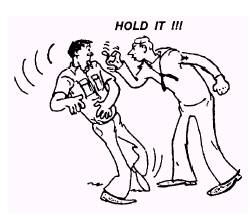
The adage "The customer is always right" is not always true. No customer has the right to personally abuse a contact point representative. However, the customer who is allowed the opportunity to "blow off steam" (within reason) may then become apologetic and ready to accept your help. When faced with an upset customer, remember that your purpose is to serve the customer's needs. Any other response on your part may serve to justify the customer's negative attitude.
A calm, confident manner is the best approach. When you do not respond with anger or rudeness to a customer's emotional outburst, you have taken the first step toward solving the customer's problem, whatever its nature.
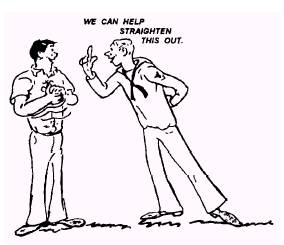
Maintaining Self-Control Earlier when we discussed your attitude toward customers, we were taking about customers in general. Although personal interaction isn't difficult when your customers are pleasant, it may become difficult when the person is unpleasant. Occasionally, you will have a customer who seems to rub you the wrong way. No matter how hard you try, you can't remain pleasant or friendly because of the customer's attitude or manner of speaking. In this situation the best solution is usually to keep the contact as impersonal as possible. Ignore the customer's manner and attitude and concentrate on the problem. Your performance is viewed by the customer, your coworkers, and your supervisor. For them to rate you as a person who does your best work, you must maintain self-control. Running out of patience and allowing your temper to flare reduces your ability to think and act properly. Determining the Specific Problem Frequently when customers have a need, they tell you the results they want instead of telling you the problem; you then must identify the nature or cause of the problem and provide a satisfactory solution. Case Number 4 is an example of this situation. In this example, SN Frost wanted to know why he wasn't allowed to take the advancement examination so that he could advance to PO3. Before the PN could answer that question, she first had to identify SN Frost's specific problem. You must be familiar with all areas of your rating to be able to identify specific problems and to know where to find specific answers. For example, to identify a specific health problem, medical personnel must know the symptoms of certain illnesses. Once they have identified the illness, they must know where to find solutions to treating the illness. In the same way, you must be able to identify the real problem behind the customer's actions and words. Once you have identified the problem, you must know where to go for a solution. Identifying Contributing Causes Most customers have routine, easily identifiable problems. You can solve these problems without any great difficulty. However, there are exceptions, such as in Case Number 5. In this instance, a problem of no pay resulted from an error that had occurred at the previous command. The problem was further complicated by the customer's emotions. To solve the problem, both the customer and the contact point representatives had to have a mutual desire to achieve results. The YN and the disbursing officer had to identify the problem and then take positive action to correct it. Contact point representatives must be especially alert at all stations that serve as home ports for ships. Because its natural for ships to deploy, it is just as natural for the home port to be a massive contact point for spouses remaining behind. All Navy spouses will vouch that everything generally runs smoothly until the ship disappears over the horizon. Then the roof caves in! When both partners-husband and wife-are at home, both can work jointly to solve problems; but when alone the spouse must handle the problems the best way possible. A Navy spouse, husband or wife, has a strong influence on the decision of the member to reenlist (ship over) or return to the civilian sector. That is not unreasonable. After all, the problems that arise in a marriage are best handled by both partners. When the husband or wife is absent because of deployments, training, or upkeep, the spouse may be unfamiliar with Navy procedures or with the area. These unknowns may further complicate problems that already exist. The Navy spouse doesn't need added complications to an already stressful situation. This is no time for wrong answers or indifferent service. Therefore, when your customers are Navy dependents, make sure they receive the services to which they are entitled. |
 |
|
|
||