Custom Search
|
|
 
|
||
|
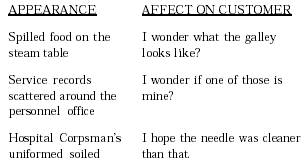
CHAPTER 3 MANNING THE CONTACT POINT LEARNING OBJECTIVES Upon completion of this chapter, you should be able to do the following: l Discuss the first impression of your initial approach when handling customers' needs. l Discuss pitfalls to avoid when handling customers' problems. l Describe what you can do and what you should do to avoid dissatisfaction in extreme and unusual situations. l Discuss why assisting the customer is important. l Discuss the importance of working with records of customers. You often hear the lament, "No one notices the things I do right, only the things I do wrong." Unfortunately, that is too often true! Perhaps that occurs because we expect people to do things right or because we find it easier to pick out those things that are wrong and evaluate their consequences. To emphasize this point, we use examples and illustrations in this book that point out mistakes you can avoid. Chapter 1 listed several contact points to which customers could come to receive services. These may be personal services, specialized services, or routine services. The customer who wants to request a school, register an allotment, correct a service record error, or discuss a personal problem requires more than routine, impersonal service. You should treat that customer as an individual with a special need. Most customers have routine needs that can be met on an impersonal basis. For example, the post office sorts mail for delivery; on payday the disbursing officer verifies and distributes pay-both are routine services. Even though routine services are impersonal, that doesn't mean they are unimportant; they are both personal and important to the customer receiving them. Performing all routine services properly eliminates many customer service problems. This manual does not attempt to present customers' problems and their solutions. Rather, it identifies problems in personal interactions, discusses factors that influence attitudes, and suggests ways to improve your effectiveness. THE INITIAL APPROACH It has been said that the first impression is a lasting impression. Upon first meeting someone, you quickly form opinions based on that person's dress, speech, mannerisms, and rating or rate (if known). These first impressions are not always fair, but they do exist; they do affect our attitude. MAKING A GOOD FIRST IMPRESSION Customers form a first impression about you based on the same criteria you use to form your first impression of them. However, these impressions affect your customers differently than they affect you. You will extend service to numerous customers during the course of a day-you meet a customer, form an impression, provide a service, and then redirect your attention to the next customer. The impression you form may affect your mood, but it usually does not extend beyond the individual customer or group of customers. On the other hand, a customer's impression of you usually gets generalized to the entire office. For example, a customer has a particularly complicated problem, and you are able to solve it by looking up the applicable References. The customer may make a comment to his or her shipmates such as, "That disbursing office is on the ball. The people in that office know what they're doing." The first thing the customer notices and uses in forming an impression is appearance. Appearance includes not only your personal appearance, but also the appearance of the contact point. The appearance of the contact point reveals your attitude toward the job you are doing. A neat, efficient-looking, businesslike working space implies that the people working there are efficient and businesslike, but a space that has a patchwork appearance has the opposite effect. Although an unkempt appearance may not affect your performance, it can affect the customer; the following are some examples:
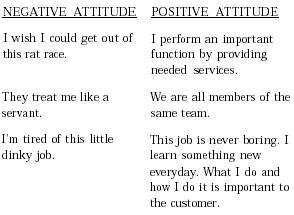
A careless attitude toward your appearance makes a customer feel you might also be careless about the service you provide. Projecting Your Attitude The customer forms a mental picture of you based on your attitude. Your attitude is a message about your mood, feelings, and opinions that you unconsciously communicate. Through your attitude, the customer soon realizes how you feel. You don' t have to express your feelings in words because your attitude expresses them for you-and it doesn't take long. Your attitude shows how you view your job, your rating, the Navy, the customer, and the customer's problem. TOWARD YOUR JOB, YOUR RATING, AND THE NAVY.- The following shows the difference in a negative and a positive attitude by two people in the same job:
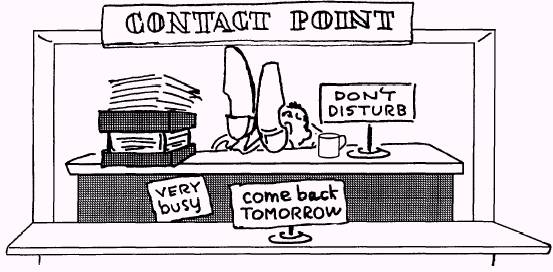
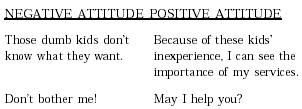
If you have a negative attitude toward your job, have you stopped to ask yourself why, and what can be done about it? Consider the following examples: Are you in a job that doesn't fully challenge you. Do you have too much time on your hands? Use this time as an opportunity to sharpen your skills to better serve at your particular contact point. You may even start looking at the demands of jobs that are more responsible. Tolay's Navy is becoming smaller; and along with that, the number of people who are willing to do more than the bare minimum is becoming smaller. Those who are willing to do more are far from being suckers. They are special in the sense that they obtain satisfaction from doing their job well. Do you view your job as being routine? Do you think it offers no challenge? If either is true, research the overall purpose or objective of your job to see how it fits into the mission of your activity or command. You will not only gain an appreciation for the importance of your job, you may qualify yourself for a more responsible position. If you are job dissatisfied, look around for a job you would prefer. The next step would be to qualify yourself for that job. To illustrate this fact, supply was fortunate to have a conscientious SKSN. He had mastered several rather complex accounting procedures through research, practice, and personal guidance. Because of his initiative, when the SK1 assigned to the accounting department was transferred, the SKSN was immediately assigned his duties. The SKSN saw the job as a challenge and worked hard to get it-so can you. Regardless of how you answered these questions, you will nevertheless communicate your attitude toward your job to your customers. Your customers will quickly sense your attitude from your speech and manner. TOWARD THE CUSTOMER.- Your attitude toward the customer relates closely to your attitude toward your job. The customer quickly senses your attitude from your speech and manner. Have you ever ignored customers when they entered your office to try to impress them with how important or how busy you were? Were the customers impressed? No doubt! But, not as you may have expected. They were probably more impressed with your lack of concern for their needs. When a customer comes to you for help, a perceived level of confidence in your ability to provide it already exists. Offensive language or a superior attitude will quickly undermine this confidence. "Speaking down" implies that you consider the customer to be less than your equal. That attitude may make the customer feel that the service you provide is less than your best. The language you use can give the impression that you are speaking down, so avoid using language that might be unfamiliar to customers. You need to know what language to use, when to use it, and how to use it. When engineering or deck division personnel come into the office for information, you must use words they can understand. We will speak more about stereotyping later but for now, we want to issue a word of caution about its effect on the customer. Stereotyping is the practice of fitting people and things into preconceived molds. For Navy members, it is also the practice of fitting members of ratings or occupations into an established "norm." The fallacy of this practice is that hardly anyone fits into that norm. The best way to avoid stereotyping is to recognize the contribution each rating makes to the Navy. True, a person outside your rating may not understand every aspect of your specialty; but how proficient are you in that person's specialty? Try to identify whether you have the habit of stereotyping your customers. Then take steps to overcome that habit. Though you may not be aware of the habit, the CUSTOMER IS AWARE OF IT. TOWARD THE CUSTOMERS' NEEDS.- The customers' needs will span the continuum from the ridiculous, through the routine, to the difficult. However, these categories reflect your opinion of the needs and requests-not the customers'. These needs, requests, and problems are important to customers; otherwise, they would not be there. You must do more than show a positive attitude toward your job and the customer; you must also show respect for the person's need for service. Disrespectful comments, such as the following, indicate that the customer's request is not important and that you have better things to occupy your time: Everybody knows that! You came all the way up here for that? You didn't know! You were supposed to be here yesterday. We'll get to it. Case Number 3 illustrates the effect of disregarding the customer's need. SN Boat may not have been eligible to strike for RM, but the response he received was not satisfactory. Instead of intimidating SN Boat into believing he couldn't qualify for RM, SN Christmas should have explained the qualifications required. LPO Brush should never have allowed or taken part in such treatment of a customer. Had they given SN Boat the answers he needed, they could have met his needs even though they couldn't give him the answer he wanted. |
 |
|
|
||