Custom Search
|
|
 
|
||
|
Kinetic energy is defined as the energy stored in an object because of its motion. If you have a baseball in your hand, it has no kinetic energy because it is not moving. But if you throw the ball, your hand has provided energy to give the ball motion. When you release the ball, it leaves your hand at some velocity. The energy you have given the ball will determine the velocity of the ball. Because the kinetic energy is due to the motion of the object, and motion is measured by velocity, kinetic energy can be calculated in terms of its velocity, as shown below.
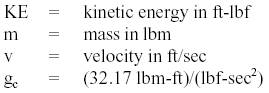
where:
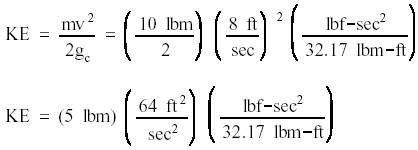
Example: What is the kinetic energy of a 10 lbm object that has a velocity of 8 ft/sec?
Answer: KE = 9.95 ft-lbf The kinetic energy of an object represents the amount of energy required to increase the velocity of the object from rest (v = 0) to its final velocity, or the work it can do as it pushes against something in slowing down (waterwheel or turbine, for example.) |
 |
|
|
||