Custom Search
|
|
 
|
||
|
Coefficients and Reactivitv Defects The
amount of reactivity ( To
quantify the effect that a variation in parameter (that is, increase in
temperature, control rod insertion, increase in neutron poison) will have on
the reactivity of the core, reactivity
coefficients are used. Reactivity coefficients are the amount that the
reactivity will change for a given change in the parameter. For instance, an
increase in moderator temperature will cause a decrease in the reactivity of
the core. The amount of reactivity change per degree change in the moderator
temperature is the moderator temperature coefficient. Typical units for the
moderator temperature coefficient are pcm/F. Reactivity coefficients are
generally symbolized by
If
the parameter x increases and positive reactivity is added, then Reactivity defects (
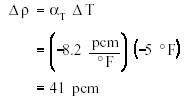
Example: The moderator temperature coefficient for a reactor is -8.2 pcmpF. Calculate the reactivity defect that results from a temperature decrease of 5F. Solution:
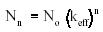
The reactivity addition due to the temperature decrease was positive because of the negative temperature coefficient. Summary The important information in this chapter is summarized below. Reactivity Summary The number of neutrons present in the core after a given number of generations is calculated using Equation (3-4).
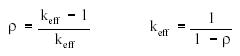
Reactivity is the fractional change in neutron population per generation. Reactivity and keff are represented in Equation (3-5) and Equation (3-6), respectively.
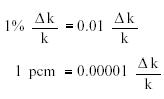
The relationship between units of reactivity are listed below.
A reactivity coefficient is the amount of change in reactivity per unit change in the parameter. A reactivity defect is the total reactivity change caused by a change in the parameter. The reactivity defect is the product of the reactivity coefficient and the magnitude of the parameter change. |
 |
|
|
||












 ) in a reactor core determines what the
  ,
where x represents some variable reactor parameter that affects reactivity. The
definition of a
,
where x represents some variable reactor parameter that affects reactivity. The
definition of a 
 )
are the total reactivity change caused by a variation in a parameter.
Reactivity defects can be determined by multiplying the change in the parameter
by the
)
are the total reactivity change caused by a variation in a parameter.
Reactivity defects can be determined by multiplying the change in the parameter
by the