

Custom Search
|
|
 
|
||
|
Multiplication Factor, k_ Not all of the neutrons produced by fission will have the opportunity to cause new fissions because some neutrons will be absorbed by non-fissionable material. Some will be absorbed parasitically in fissionable material and will not cause fission, and others will leak out of the reactor. For the maintenance of a self-sustaining chain reaction, however, it is not necessary that every neutron produced in fission initiate another fission. The minimum condition is for each nucleus undergoing fission to produce, on the average, at least one neutron that causes fission of another nucleus. This condition is conveniently expressed in terms of a multiplication factor. The
number of neutrons absorbed or leaking out of the reactor will determine the
value of this multiplication factor, and will also determine whether a new
generation of neutrons is larger, smaller, or the same size as the preceding
generation. Any reactor of a finite size will have neutrons leak out of it.
Generally, the larger the reactor, the lower the fraction of neutron leakage.
For simplicity, we will first consider a reactor that is infinitely large, and
therefore has no neutron leakage. A measure of the increase or decrease in
neutron flux in an infinite reactor is the infinite multiplication factor, k
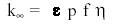
A group of fast neutrons produced by fission can enter into several reactions. Some of these reactions reduce the size of the neutron group while other reactions allow the group to increase in size or produce a second generation. There are four factors that are completely independent of the size and shape of the reactor that give the inherent multiplication ability of the fuel and moderator materials without regard to leakage. This four factor formula accurately represents the infinite multiplication factor as shown in the equation below.
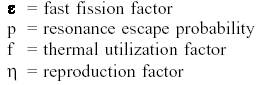
where:
Each of these four factors, which are explained in the following subsections, represents a process that adds to or subtracts from the initial neutron group produced in a generation by fission. The first process that the neutrons of one generation may
undergo is fast fission. Fast fission is fission caused by neutrons that are in
the fast energy range. Fast fission results in the net increase in the fast
neutron population of the reactor core. The cross section for fast fission in
uranium-235 or uranium-238 is small; therefore, only a small number of fast
neutrons cause fission. The fast neutron population in one generation is
therefore increased by a factor called the fast fission factor. The fast
fission factor (
In order for a neutron to be absorbed by a fuel nucleus as
a fast neutron, it must pass close enough to a fuel nucleus while it is a fast
neutron. The value of |
 |
|
|
||
|
|
Integrated Publishing, Inc. - A (SDVOSB) Service Disabled Veteran Owned Small Business
|













 )
)
 will be affected by the arrangement and concentrations
of the fuel and the moderator. The value of
will be affected by the arrangement and concentrations
of the fuel and the moderator. The value of 