Custom Search
|
|
  |
|
|
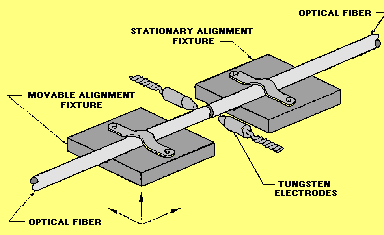
FUSION SPLICES The process of fusion splicing involves using localized heat to melt or fuse the ends of two optical fibers together. The splicing process begins by preparing each fiber end for fusion. Fusion splicing requires that all protective coatings be removed from the ends of each fiber. The fiber is then cleaved using the score-and-break method. The quality of each fiber end is inspected using a microscope. In fusion splicing, splice loss is a direct function of the angles and quality of the two fiber-end faces. The basic fusion splicing apparatus consists of two fixtures on which the fibers are mounted and two electrodes. Figure 4-13 shows a basic fusion-splicing apparatus. An inspection microscope assists in the placement of the prepared fiber ends into a fusion-splicing apparatus. The fibers are placed into the apparatus, aligned, and then fused together. Initially, fusion splicing used nichrome wire as the heating element to melt or fuse fibers together. New fusion-splicing techniques have replaced the nichrome wire with carbon dioxide (CO2) lasers, electric arcs, or gas flames to heat the fiber ends, causing them to fuse together. The small size of the fusion splice and the development of automated fusion-splicing machines have made electric arc fusion (arc fusion) one of the most popular splicing techniques in commercial applications. Figure 4-13. - A basic fusion splicing apparatus. Arc fusion involves the discharge of electric current across a gap between two electrodes. By placing the fiber ends between the electrodes, the electric discharge melts or fuses the ends of each fiber. Figure 4-13 shows the placement of the fiber ends between tungsten electrodes during arc fusion. Initially, a small gap is present between the fiber ends. A short discharge of electric current is used to prepare the fiber ends for fusion. During this short discharge, known as prefusion, the fiber ends are cleaned and rounded to eliminate any surface defects that remain from fiber cleaving. Surface defects can cause core distortions or bubble formations during fiber fusion. A fusion splice results when the fiber ends are pressed together, actively aligned, and fused using a longer and stronger electric discharge. Automated fusion splicers typically use built-in local optical power launch/detection schemes for aligning the fibers. During fusion, the surface tension of molten glass tends to realign the fibers on their outside diameters, changing the initial alignment. When the fusion process is complete, a small core distortion may be present. Small core distortions have negligible effects on light propagating through multimode fibers. However, a small core distortion can significantly affect single mode fiber splice loss. The core distortion, and the splice loss, can be reduced by limiting the arc discharge and decreasing the gap distance between the two electrodes. This limits the region of molten glass. However, limiting the region of molten glass reduces the tensile strength of the splice. Fusion splicing yields typically vary between 25 and 75 percent depending on the strength and loss requirements for the splice and other factors. Other factors affecting splice yields include the condition of the splicing machine, the experience of the splice personnel, and environmental conditions. Since fusion splicing is inherently permanent, an unacceptable fusion splice requires breakage and refabrication of the splice. In general, fusion splicing takes a longer time to complete than mechanical splicing. Also, yields are typically lower making the total time per successful splice much longer for fusion splicing. Both the yield and splice time are determined to a large degree by the expertise of the fusion splice operator. Fusion splice operators must be highly trained to consistently make low-loss reliable fusion splices. For these reasons the fusion splice is not recommended for use in Navy shipboard applications. Q.20 What fiber property directly affects splice loss in fusion splicing? |
 |