Custom Search
|
|
  |
|
|
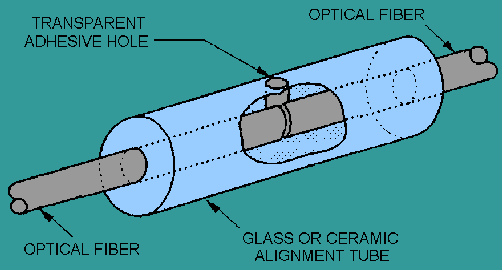
MECHANICAL SPLICES Mechanical splicing involves using mechanical fixtures to align and connect optical fibers. Mechanical splicing methods may involve either passive or active core alignment. Active core alignment produces a lower loss splice than passive alignment. However, passive core alignment methods can produce mechanical splices with acceptable loss measurements even with single mode fibers. In the strictest sense, a mechanical splice is a permanent connection made between two optical fibers. Mechanical splices hold the two optical fibers in alignment for an indefinite period of time without movement. The amount of splice loss is stable over time and unaffected by changes in environmental or mechanical conditions. If high splice loss results from assembling some mechanical splices, the splice can be reopened and the fibers realigned. Realignment includes wiping the fiber or ferrule end with a soft wipe, reinserting the fiber or ferrule in a new arrangement, and adding new refractive index material. Once producing an acceptable mechanical splice, splice realignment should be unnecessary because most mechanical splices are environmentally and mechanically stable within their intended application. The types of mechanical splices that exist for mechanical splicing include glass, plastic, metal, and ceramic tubes; and V-groove and rotary devices. Materials that assist mechanical splices in splicing fibers include transparent adhesives and index matching gels. Transparent adhesives are epoxy resins that seal mechanical splices and provide index matching between the connected fibers. Glass or Ceramic Alignment Tube Splices Mechanical splicing may involve the use of a glass or ceramic alignment tube, or capillary. The inner diameter of this glass or ceramic tube is only slightly larger than the outer diameter of the fiber. A transparent adhesive, injected into the tube, bonds the two fibers together. The adhesive also provides index matching between the optical fibers. Figure 4-9 illustrates fiber alignment using a glass or ceramic tube. This splicing technique relies on the inner diameter of the alignment tube. If the inner diameter is too large, splice loss will increase because of fiber misalignment. If the inner diameter is too small, it is impossible to insert the fiber into the tube. Figure 4-9. - A glass or ceramic alignment tube for mechanical splicing.
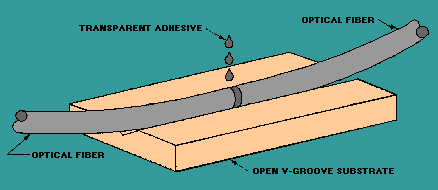
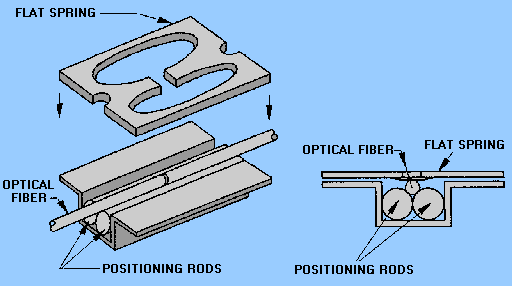
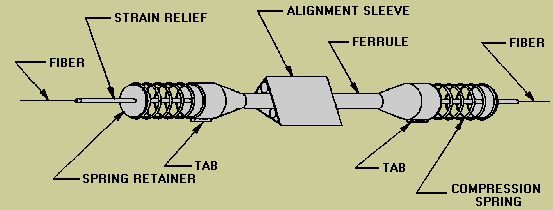
V-Grooved Splices Mechanical splices may also use either a grooved substrate or positioning rods to form suitable V-grooves for mechanical splicing. The basic V-grooved device relies on an open grooved substrate to perform fiber alignment. When inserting the fibers into the grooved substrate, the V-groove aligns the cladding surface of each fiber end. A transparent adhesive makes the splice permanent by securing the fiber ends to the grooved substrate. Figure 4-10 illustrates this type of open V-grooved splice. Figure 4-10. - Open V-grooved splice. V-grooved splices may involve sandwiching the butted ends of two prepared fibers between a V-grooved substrate and a flat glass plate. Additional V-grooved devices use two or three positioning rods to form a suitable V-groove for splicing. The V-grooved device that uses two positioning rods is the spring V-grooved splice. This splice uses a groove formed by two rods positioned in a bracket to align the fiber ends. The diameter of the positioning rods permits the outer surface of each fiber end to extend above the groove formed by the rods. A flat spring presses the fiber ends into the groove maintaining fiber alignment. Transparent adhesive completes the assembly process by bonding the fiber ends and providing index matching. Figure 4-11 is an illustration of the spring V-grooved splice. A variation of this splice uses a third positioning rod instead of a flat spring. The rods are held in place by a heat-shrinkable band, or tube. Figure 4-11. - Spring V-grooved mechanical splice. Rotary Splices In a rotary splice, the fibers are mounted into a glass ferrule and secured with adhesives. The splice begins as one long glass ferrule that is broken in half during the assembly process. A fiber is inserted into each half of the tube and epoxied in place using an ultraviolet cure epoxy. The endface of the tubes are then polished and placed together using the alignment sleeve. Figure 4-12 is an illustration of a rotary splice. The fiber ends retain their original orientation and have added mechanical stability since each fiber is mounted into a glass ferrule and alignment sleeve. The rotary splice may use index matching gel within the alignment sleeve to produce low-loss splices. Figure 4-12. - Rotary mechanical splice. In shipboard applications, the Navy recommends using the rotary splice. The rotary splice is a low-loss mechanical splice that provides stable environmental and mechanical performance in the Navy environment. Stable performance means that splice loss does not vary significantly with changes in temperature or other environmental or mechanical conditions. Completing a rotary splice also requires only a small amount of training, or expertise. This shorter training time is another reason why the Navy recommends using the rotary splice over other mechanical or fusion splicing techniques. Q.18 Describe a transparent adhesive. |
|