Custom Search
|
|
  |
|
|
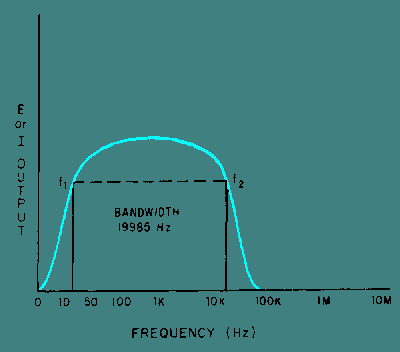
SUMMARY This chapter has presented information on video and rf amplifiers. The information that follows summarizes the important points of this chapter. A FREQUENCY-RESPONSE CURVE will enable you to determine the BANDWIDTH and the UPPER and LOWER FREQUENCY LIMITS of an amplifier.
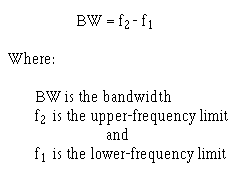
THE BANDWIDTH of an amplifier is determined by the formula:
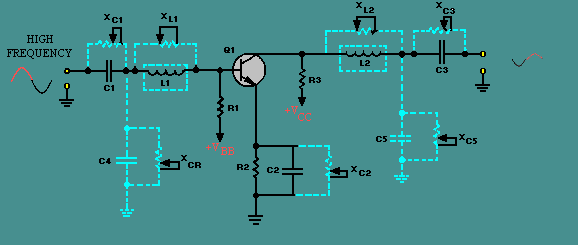
THE UPPER-Frequency response of an amplifier is limited by the inductance and capacitance of the circuit.
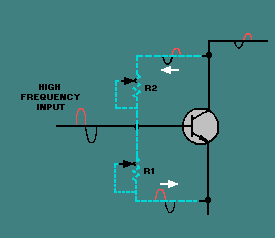
THE INTERELECTRODE CAPACITANCE of a transistor causes DEGENERATIVE FEEDBACK at high frequencies.
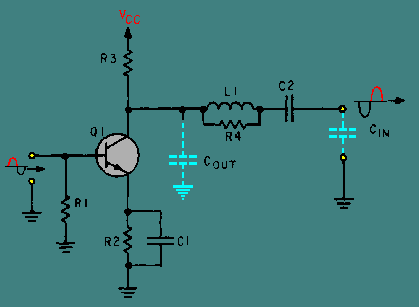
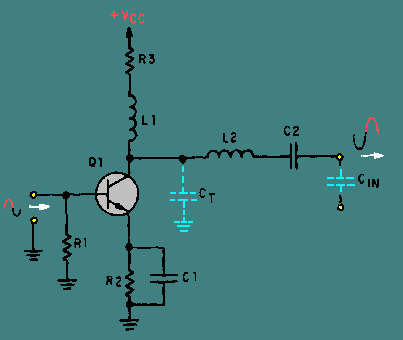
VIDEO AMPLIFIERS must have a Frequency response of 10 hertz to 6 megahertz (10 Hz - 6 MHz). To provide this Frequency response, both high- and low-frequency compensation must be used. PEAKING COILS are used in video amplifiers to overcome the high-frequency limitations caused by the capacitance of the circuit. SERIES PEAKING is accomplished by a peaking coil in series with the output-signal path.
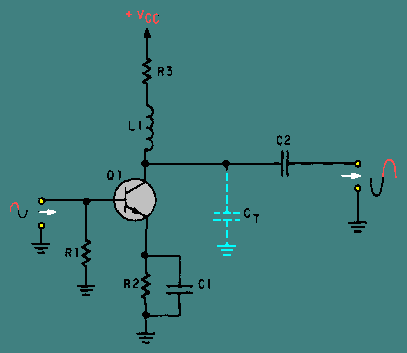
SHUNT PEAKING is accomplished by a peaking coil in parallel (shunt) with the output-signal path.
COMBINATION PEAKING is accomplished by using both series and shunt peaking.
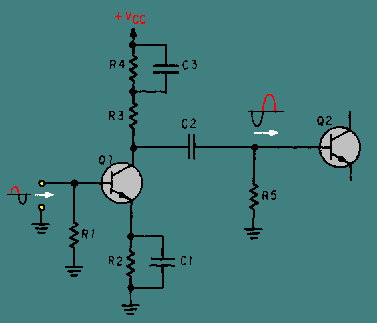
LOW-FREQUENCY COMPENSATION is accomplished in a video amplifier by the use of a parallel RC circuit in series with the load resistor.
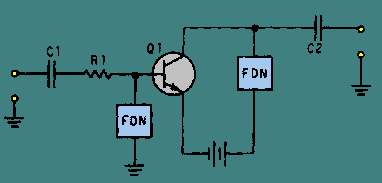
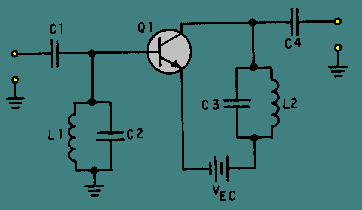
A RADIO-FREQUENCY (RF) AMPLIFIER uses FREQUENCY-DETERMINING NETWORKS to provide the required response at a given frequency.
THE FREQUENCY-DETERMINING NETWORK in an rf amplifier provides maximum impedance at the desired frequency. It is a parallel LC circuit which is called a TUNED CIRCUIT.
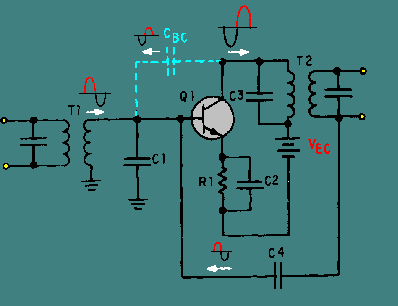
TRANSFORMER COUPLING is the most common form of coupling in rf amplifiers. This coupling is accomplished by the use of rf transformers as part of the frequency-determining network for the amplifier.
ADEQUATE BANDPASS is accomplished by optimum coupling in the rf transformer or by the use of a SWAMPING RESISTOR. NEUTRALIZATION in an rf amplifier provides feedback (usually positive) to overcome the effects caused by the base-to-collector interelectrode capacitance.
|
 |
|
|
Integrated Publishing, Inc. - A (SDVOSB) Service Disabled Veteran Owned Small Business
|