Custom Search
|
|
  |
|
|
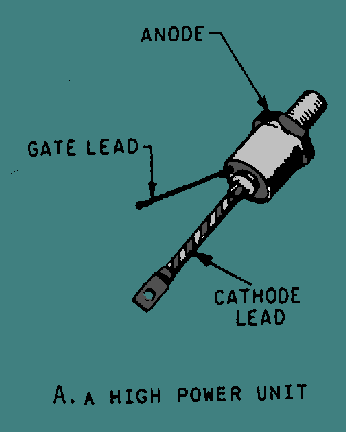
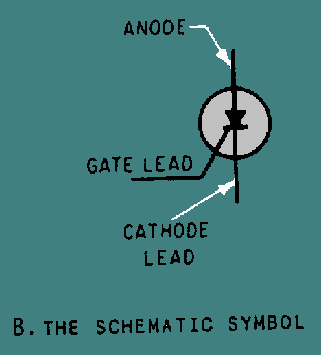
Silicon Controlled Rectifier (SCR) The SILICON CONTROLLED RECTIFIER, usually referred to as an SCR, is one of the family of semiconductors that includes transistors and diodes. A drawing of an SCR and its schematic representation is shown in views A and B of figure 3-17. Not all SCRs use the casing shown, but this is typical of most of the high-power units. Figure 3-17A. - Silicon controlled rectifier.
Figure 3-17B. - Silicon controlled rectifier.
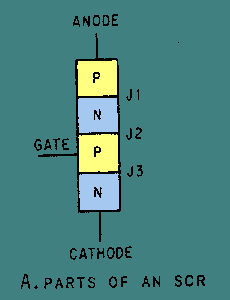
Although it is not the same as either a diode or a transistor, the SCR combines features of both. Circuits using transistors or rectifier diodes may be greatly improved in some instances through the use of SCRs. The basic purpose of the SCR is to function as a switch that can turn on or off small or large amounts of power. It performs this function with no moving parts that wear out and no points that require replacing. There can be a tremendous power gain in the SCR; in some units a very small triggering current is able to switch several hundred amperes without exceeding its rated abilities. The SCR can often replace much slower and larger mechanical switches. It even has many advantages over its more complex and larger electron tube equivalent, the thyratron. The SCR is an extremely fast switch. It is difficult to cycle a mechanical switch several hundred times a minute; yet, some SCRs can be switched 25,000 times a second. It takes just microseconds (millionths of a second) to turn on or off these units. Varying the time that a switch is on as compared to the time that it is off regulates the amount of power flowing through the switch. Since most devices can operate on pulses of power (alternating current is a special form of alternating positive and negative pulse), the SCR can be used readily in control applications. Motor-speed controllers, inverters, remote switching units, controlled rectifiers, circuit overload protectors, latching relays, and computer logic circuits all use the SCR. The SCR is made up of four layers of semiconductor material arranged PNPN. The construction is shown in view A of figure 3-18. In function, the SCR has much in common with a diode, but the theory of operation of the SCR is best explained in terms of transistors. Figure 3-18A. - SCR structure.
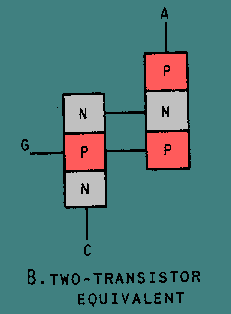
Consider the SCR as a transistor pair, one PNP and the other NPN, connected as shown in views B and C. The anode is attached to the upper P-layer; the cathode, C, is part of the lower N-layer; and the gate terminal, G, goes to the P-layer of the NPN triode. Figure 3-18B. - SCR structure.
|
 |