Custom Search
|
|
  |
|
|
SINGLE-PHASE INDUCTION MOTORS
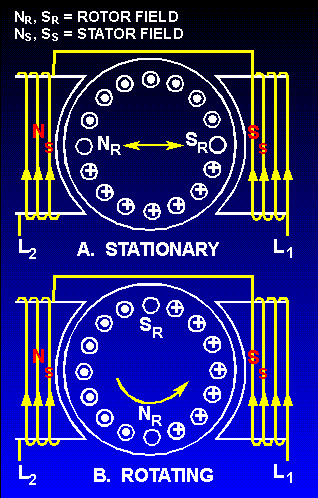
There are probably more single-phase ac induction motors in use today than the total of all the other types put together. It is logical that the least expensive, lowest maintenance type of ac motor should be used most often. The single-phase ac induction motor fits that description. Unlike polyphase induction motors, the stator field in the single-phase motor does not rotate. Instead it simply alternates polarity between poles as the ac voltage changes polarity. Voltage is induced in the rotor as a result of magnetic induction, and a magnetic field is produced around the rotor. This field will always be in opposition to the stator field (Lenz's law applies). The interaction between the rotor and stator fields will not produce rotation, however. The interaction is shown by the double-ended arrow in figure 4-10, view A. Because this force is across the rotor and through the pole pieces, there is no rotary motion, just a push and/or pull along this line. Figure 4-10. - Rotor currents in a single-phase ac induction motor.
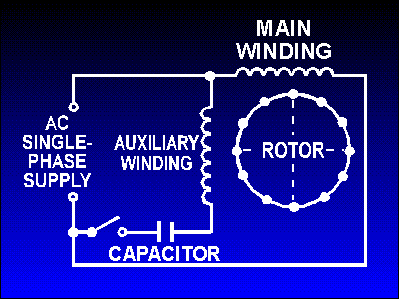
Now, if the rotor is rotated by some outside force (a twist of your hand, or something), the push-pull along the line in figure 4-10, view A, is disturbed. Look at the fields as shown in figure 4-10, view B. At this instant the south pole on the rotor is being attracted by the left-hand pole. The north rotor pole is being attracted to the right-hand pole. All of this is a result of the rotor being rotated 90 by the outside force. The pull that now exists between the two fields becomes a rotary force, turning the rotor toward magnetic correspondence with the stator. Because the two fields continuously alternate, they will never actually line up, and the rotor will continue to turn once started. It remains for us to learn practical methods of getting the rotor to start. There are several types of single-phase induction motors in use today. Basically they are identical except for the means of starting. In this chapter we will discuss the split-phase and shaded-pole motors; so named because of the methods employed to get them started. Once they are up to operating speed, all single-phase induction motors operate the same. Q.11 What type of ac motor is most widely used? Split-Phase Induction Motors One type of induction motor, which incorporates a starting device, is called a split-phase induction motor. Split-phase motors are designed to use inductance, capacitance, or resistance to develop a starting torque. The principles are those that you learned in your study of alternating current. CAPACITOR-START. - The first type of split-phase induction motor that will be covered is the capacitor-start type. Figure 4-11 shows a simplified schematic of a typical capacitor-start motor. The stator consists of the main winding and a starting winding (auxiliary). The starting winding is connected in parallel with the main winding and is placed physically at right angles to it. A 90-degree electrical phase difference between the two windings is obtained by connecting the auxiliary winding in series with a capacitor and starting switch. When the motor is first energized, the starting switch is closed. This places the capacitor in series with the auxiliary winding. The capacitor is of such value that the auxiliary circuit is effectively a resistive-capacitive circuit (referred to as capacitive reactance and expressed as XC). In this circuit the current leads the line voltage by about 45 (because XC about equals R). The main winding has enough resistance-inductance (referred to as inductive reactance and expressed as XL) to cause the current to lag the line voltage by about 45 (because XL about equals R). The currents in each winding are therefore 90 out of phase - so are the magnetic fields that are generated. The effect is that the two windings act like a two-phase stator and produce the rotating field required to start the motor. Figure 4-11. - Capacitor-start, ac induction motor.
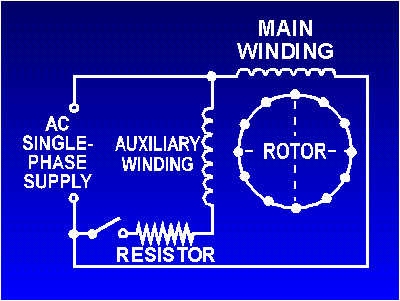
When nearly full speed is obtained, a centrifugal device (the starting switch) cuts out the starting winding. The motor then runs as a plain single-phase induction motor. Since the auxiliary winding is only a light winding, the motor does not develop sufficient torque to start heavy loads. Split-phase motors, therefore, come only in small sizes. RESISTANCE-START. - Another type of split-phase induction motor is the resistance-start motor. This motor also has a starting winding (shown in fig. 4-12) in addition to the main winding. It is switched in and out of the circuit just as it was in the capacitor-start motor. The starting winding is positioned at right angles to the main winding. The electrical phase shift between the currents in the two windings is obtained by making the impedance of the windings unequal. The main winding has a high inductance and a low resistance. The current, therefore, lags the voltage by a large angle. The starting winding is designed to have a fairly low inductance and a high resistance. Here the current lags the voltage by a smaller angle. For example, suppose the current in the main winding lags the voltage by 70. The current in the auxiliary winding lags the voltage by 40. The currents are, therefore, out of phase by 30. The magnetic fields are out of phase by the same amount. Although the ideal angular phase difference is 90 for maximum starting torque, the 30-degree phase difference still generates a rotating field. This supplies enough torque to start the motor. When the motor comes up to speed, a speed-controlled switch disconnects the starting winding from the line, and the motor continues to run as an induction motor. The starting torque is not as great as it is in the capacitor-start. Figure 4-12. - Resistance-start ac induction motor.
Q.12 How do split-phase induction motors become self-starting? |
 |
|
|
Integrated Publishing, Inc. - A (SDVOSB) Service Disabled Veteran Owned Small Business
|