Custom Search
|
|
  |
|
|
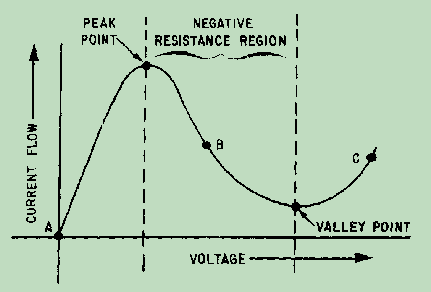
SOLID-STATE MICROWAVE DEVICES As with vacuum tubes, the special electronics effects encountered at microwave frequencies severely limit the usefulness of transistors in most circuit applications. The need for small-sized microwave devices has caused extensive research in this area. This research has produced solid-state devices with higher and higher frequency ranges. The new solid-state microwave devices are predominantly active, two-terminal diodes, such as tunnel diodes, varactors, transferred-electron devices, and avalanche transit-time diodes. This section will describe the basic theory of operation and some of the applications of these relatively new solid-state devices. Tunnel Diode Devices The TUNNEL DIODE is a pn junction with a very high concentration of impurities in both the p and n regions. The high concentration of impurities causes it to exhibit the properties of a negative-resistance element over part of its range of operation, as shown in the characteristic curve in figure 2-39. In other words, the resistance to current flow through the tunnel diode increases as the applied voltage increases over a portion of its region of operation. Outside the negative-resistance region, the tunnel diode functions essentially the same as a normal diode. However, the very high impurity density causes a junction depletion region so narrow that both holes and electrons can transfer across the pn junction by a quantum mechanical action called TUNNELING. Tunneling causes the negative-resistance action and is so fast that no transit-time effects occur even at microwave frequencies. The lack of a transit-time effect permits the use of tunnel diodes in a wide variety of microwave circuits, such as amplifiers, oscillators, and switching devices. The detailed theory of tunnel-diode operation and the negative-resistance property exhibited by the tunnel diode was discussed in NEETS, Module 7, Introduction to Solid-State Devices and Power Supplies, Chapter 3. Figure 2-39. - Tunnel-diode characteristic curve.
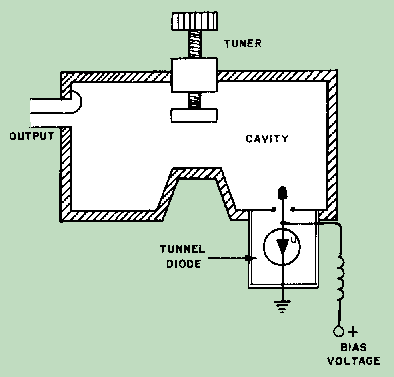
TUNNEL-DIODE OSCILLATORS. - A tunnel diode, biased at the center point of the negative-resistance range (point B in figure 2-39) and coupled to a tuned circuit or cavity, produces a very stable oscillator. The oscillation frequency is the same as the tuned circuit or cavity frequency. Microwave tunnel-diode oscillators are useful in applications that require microwatts or, at most, a few milliwatts of power, such as local oscillators for microwave superheterodyne receivers. Tunnel-diode oscillators can be mechanically or electronically tuned over frequency ranges of about one octave and have a top-end frequency limit of approximately 10 gigahertz. Tunnel-diode oscillators that are designed to operate at microwave frequencies generally use some form of transmission line as a tuned circuit. Suitable tuned circuits can be built from coaxial lines, transmission lines, and waveguides. An example of a highly stable tunnel-diode oscillator is shown in figure 2-40. A tunnel-diode is loosely coupled to a high-Q tunable cavity. Loose coupling is achieved by using a short, antenna feed probe placed off-center in the cavity. Loose coupling is used to increase the stability of the oscillations and the output power over a wider bandwidth. Figure 2-40. - Tunnel-diode oscillator.
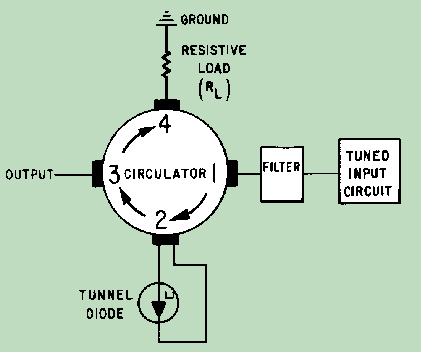
The output power produced is in the range of a few hundred microwatts, sufficient for many microwave applications. The frequency at which the oscillator operates is determined by the physical positioning of the tuner screw in the cavity. Changing the output frequency by this method is called MECHANICAL TUNING. In addition to mechanical tuning, tunnel-diode oscillators may be tuned electronically. One method is called BIAS TUNING and involves nothing more than changing the bias voltage to change the bias point on the characteristic curve of the tunnel-diode. Another method is called VARACTOR TUNING and requires the addition of a varactor to the basic circuit. Varactors were discussed in NEETS, Module 7, Introduction to Solid-State Devices, and Power Supplies, Chapter 3. Tuning is achieved by changing the voltage applied across the varactor which alters the capacitance of the tuned circuit. TUNNEL-DIODE AMPLIFIERS. - Low-noise, tunnel-diode amplifiers represent an important microwave application of tunnel diodes. Tunnel-diode amplifiers with frequencies up to 85 gigahertz have been built in waveguides, coaxial lines, and transmission lines. The low-noise generation, gain ratios of up to 30 dB, high reliability, and light weight make these amplifiers ideal for use as the first stage of amplification in communications and radar receivers. Most microwave tunnel-diode amplifiers are REFLECTION-TYPE, CIRCULATOR-COUPLED AMPLIFIERS. As in oscillators, the tunnel diode is biased to the center point of its negative-resistance region, but a CIRCULATOR replaces the tuned cavity. A circulator is a waveguide device that allows energy to travel in one direction only, as shown in figure 2-41. The tunnel diode in figure 2-41 is connected across a tuned-input circuit. This arrangement normally produces feedback that causes oscillations if the feedback is allowed to reflect back to the tuned-input circuit. The feedback is prevented because the circulator carries all excess energy to the absorptive load (RL). In this configuration the tunnel diode cannot oscillate, but will amplify. Figure 2-41. - Tunnel-diode amplifier.
The desired frequency input signal is fed to port 1 of the circulator through a bandpass filter. The filter serves a dual purpose as a bandwidth selector and an impedance-matching device that improves the gain of the amplifiers. The input energy enters port 2 of the circulator and is amplified by the tunnel diode. The amplified energy is fed from port 2 to port 3 and on to the mixer. If any energy is reflected from port 3, it is passed to port 4, where it is absorbed by the matched load resistance. TUNNEL-DIODE FREQUENCY CONVERTERS AND MIXERS. - Tunnel diodes make excellent mixers and frequency converters because their current-voltage characteristics are highly nonlinear. While other types of frequency converters usually have a conversion power loss, tunnel-diode converters can actually have a conversion power gain. A single tunnel diode can also be designed to act as both the nonlinear element in a converter and as the negative-resistance element in a local oscillator at the same time. Practical tunnel-diode frequency converters usually have either a unity conversion gain or a small conversion loss. Conversion gains as high as 20 dB are possible if the tunnel diode is biased near or into the negative-resistance region. Although high gain is useful in some applications, it presents problems in stability. For example, the greatly increased sensitivity to variations in input impedance can cause high-gain converters to be unstable unless they are protected by isolation circuitry. As with tunnel-diode amplifiers, low-noise generation is one of the more attractive characteristics of tunnel-diode frequency converters. Low-noise generation is a primary concern in the design of today's extremely sensitive communications and radar receivers. This is one reason tunnel-diode circuits are finding increasingly wide application in these fields. Q.48 Name the procedure used to reduce excessive arcing in a magnetron? |
 |
|
|
Integrated Publishing, Inc. - A (SDVOSB) Service Disabled Veteran Owned Small Business
|