Order this information in Print

Order this information on CD-ROM

Download in PDF Format


Click here to make tpub.com your Home Page

Page Title: Simultaneous Non-Harmonic Tones
Back | Up | Next

tpub.com Updates

Google


Web
www.tpub.com

Home

   
Information Categories
.... Administration
Advancement
Aerographer
Automotive
Aviation
Combat
Construction
Diving
Draftsman
Engineering
Electronics
Food and Cooking
Math
Medical
Music
Nuclear Fundamentals
Photography
Religion
USMC
   
Products
  Educational CD-ROM's
Printed Manuals
Downloadable Books


Back
Anticipation
Up
Harmony for Musicians
Next
Chordal Sevenths

Back ] Home ] Up ] Next ]

SIMULTANEOUS NON-HARMONIC TONES
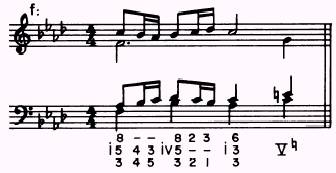
More than one non-harmonic tone may occur at a given point. Simultaneous non-harmonic tones normally form harmonic intervals of thirds, sixths, or octaves. The octave occurs when two passing tones move in contrary motion. This is called passing through the octave.

FIGURE 8.22: Passing Through the Octave
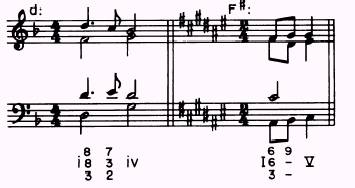
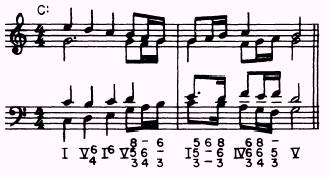
Simultaneous non-harmonic tones may be figured two ways. Vertical combinations are figured with the numerals arranged from highest to lowest, regardless of the voices in which the non-harmonic tones occur.

FIGURE 8.23: Vertical Figuring for Simultaneous Non-Harmonic Tones
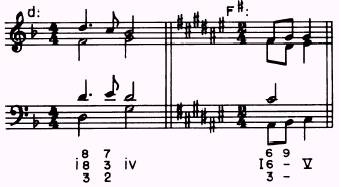
Linear movement of individual voices is figured starting from the figuring of the chord's position.

FIGURE 8.24: Linear Figuring for Simultaneous Non-Harmonic Tones
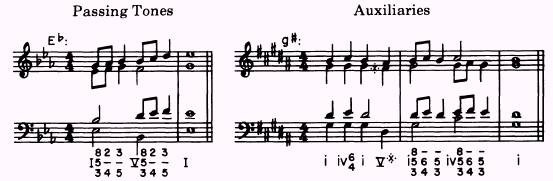
Non-harmonic tones of the same kind can occur simultaneously. The most common are passing tones or auxiliaries. Some have become so widely used that a change of chord analysis may occur (auxiliary ).

FIGURE 8.25: Passing Tones and Auxiliaries used Simultaneously
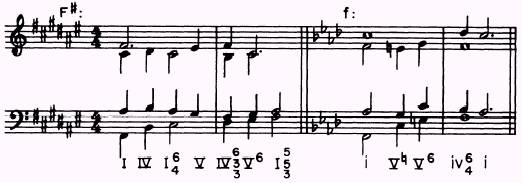
Another kind of simultaneous use is the appoggiatura six-four. It is similar to a cadential six-four. It uses the 6 to 5 and 4 to 3 voice leading and appears in a strong-weak rhythmic relationship, but not at a cadence. The two uses of the appoggiatura six-four are the I to V or IV to I.

FIGURE 8.26: Appoggiatura Six-Four
Non-harmonic tones of different kinds also occur simultaneously. A passing six-four is an example of the use of passing tones, passing through the octave, combined with a lower auxiliary.

FIGURE 8.27: Comparison of Passing Six-Four and Simultaneous Use of Different
Non-Harmonic Tones

Back ] Home ] Up ] Next ]

This information is now available on CD in Adobe PDF Printable Format


Privacy Statement - Press Release - Copyright Information. - Contact Us - Support Integrated Publishing