Order this information in Print

Order this information on CD-ROM

Download in PDF Format


Click here to make tpub.com your Home Page

Page Title: Cambiata
Back | Up | Next

tpub.com Updates

Google


Web
www.tpub.com

Home

   
Information Categories
.... Administration
Advancement
Aerographer
Automotive
Aviation
Combat
Construction
Diving
Draftsman
Engineering
Electronics
Food and Cooking
Math
Medical
Music
Nuclear Fundamentals
Photography
Religion
USMC
   
Products
  Educational CD-ROM's
Printed Manuals
Downloadable Books


Back
Lower Auxiliary
Up
Harmony for Musicians
Next
Anticipation

Back ] Home ] Up ] Next ]

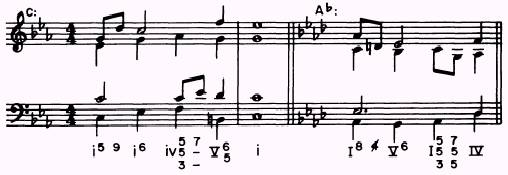
CAMBIATA
A cambiata is a non-harmonic tone approached by disjunct motion in one direction and resolved by conjunct motion in the opposite direction. It occurs in a weak rhythmic position. When a cambiata resolves upward, it may be chromatically altered to create semitone movement.

FIGURE 8.16: Cambiata
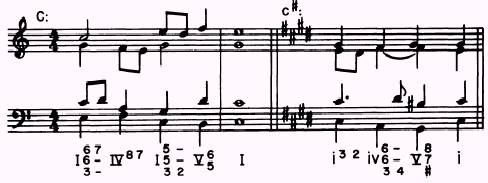
ESCHAPPEE
An eschappee (escape tone) is non-harmonic tone approached by conjunct motion and left by disjunct motion in the opposite direction. It occurs in a weak rhythmic position.

FIGURE 8.17: Eschappee

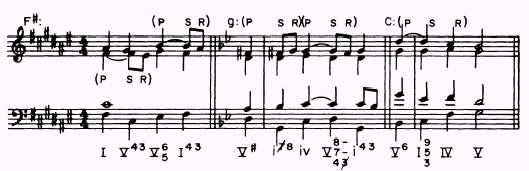
SUSPENSION
A suspension is a non-harmonic tone occurring when a note's natural melodic progression is delayed. This requires two different chords. A suspension is a chord tone in the first chord sustained or repeated in the same voice as a non-harmonic tone of the second chord. There are three parts of a suspension: preparation (P), suspension (S), and resolution (R). The preparation is a chord tone of the first chord. The suspension is non-harmonic and is the same pitch as the preparation continued to the second chord.

The resolution occurs when the suspension resolves by conjunct motion to a chord tone of the second chord. An upward resolution of a suspension is called a retardation. The note of resolution may be present if it is a compound interval below the suspension. Suspensions may be tied or dotted note values; however, when repeated, they are called struck suspensions. The suspension and resolution must be in a strong-weak rhythmic relationship. The preparation must be as long or longer than the suspension. Resolutions of suspensions may be decorated with other non-harmonic tones. Common suspensions are 9-8, 7-6, 6-5, and 4-3.

FIGURE 8.18: Suspension
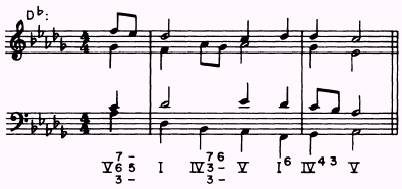
APPOGGIATURA
An appoggiatura is a non-harmonic tone a step above or below a chord tone of a single chord. It resolves to the chord tone. An appoggiatura functions as a suspension without a preparation. Normally, appoggiaturas are approached by disjunct motion in the opposite direction of the resolution, or by conjunct motion from either direction. When an appoggiatura is approached by conjunct motion in the same direction as its resolution, it is also called an accented passing tone.

FIGURE 8.19: Appoggiatura

Back ] Home ] Up ] Next ]

This information is now available on CD in Adobe PDF Printable Format


Privacy Statement - Press Release - Copyright Information. - Contact Us - Support Integrated Publishing