Order this information in Print

Order this information on CD-ROM

Download in PDF Format


Click here to make tpub.com your Home Page

Page Title: Chapter 7 - Dominant Seventh Chord
Back | Up | Next

tpub.com Updates

Google


Web
www.tpub.com

Home

   
Information Categories
.... Administration
Advancement
Aerographer
Automotive
Aviation
Combat
Construction
Diving
Draftsman
Engineering
Electronics
Food and Cooking
Math
Medical
Music
Nuclear Fundamentals
Photography
Religion
USMC
   
Products
  Educational CD-ROM's
Printed Manuals
Downloadable Books


Back
Types of Second Inversions
Up
Harmony for Musicians
Next
Figured bass and doubling

Back ] Home ] Up ] Next ]

CHAPTER7
Dominant Seventh Chord

Basic Music (TC 12-41/ NAVEDTRA 01244) describes the construction and interval relationships of a dominant seventh chord. In Harmony, the dominant seventh chord refers specifically to the diatonic chord which appears on the dominant scale degree. In minor the chord is borrowed from its parallel major just as is the dominant triad.

TRITONE RESOLUTION
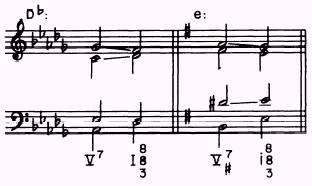
An interval of a tritone appears between the third and seventh (leading tone and subdominant scale degrees) of the dominant seventh chord. Dissonant harmonic intervals such as the tritone of the dominant seventh chord require specific resolution. A regular resolution occurs when the third (leading tone) resolves up to the root of the tonic chord and the seventh (subdominant) resolves down to the third of the tonic chord. This is the most common resolution and satisfies the melody pull of the tendency tones.

FIGURE 7.1: Regular Resolution
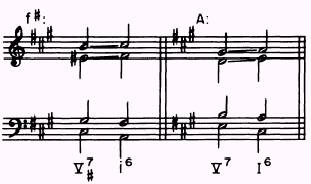
When the seventh of a dominant seventh chord appears in an upper voice and the chord progresses to a first inversion tonic chord, an Irregular Resolution must occur. The Bass voice has taken the note of resolution (third of the tonic chord) and the seventh in the upper voice will rise to the fifth of the tonic chord. This will often produce harmonic intervals of a diminished fifth followed by a perfect fifth. This is called Unequal Fifths and is acceptable under such circumstances.

FIGURE 7.2: Irregular Resolution
APPROACHING THE SEVENTH

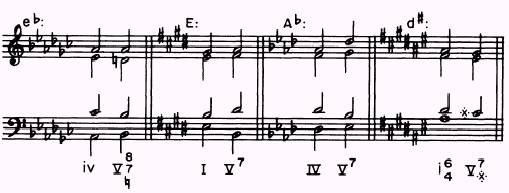
No new guidelines are required for approaching a dominant seventh chord except for the melodic approach to the seventh. The seventh of the dominant seventh chord is considered a dissonance and should not be approached by disjunct motion from above. This is a carry-over from 16th century contrapuntal technique, which required that no accented dissonance be approached in such a manner.

FIGURE 7.3: Approaching the Seventh

Back ] Home ] Up ] Next ]

This information is now available on CD in Adobe PDF Printable Format


Privacy Statement - Press Release - Copyright Information. - Contact Us - Support Integrated Publishing