Order this information in Print

Order this information on CD-ROM

Download in PDF Format


Click here to make tpub.com your Home Page

Page Title: Types of Second Inversions
Back | Up | Next

tpub.com Updates

Google


Web
www.tpub.com

Home

   
Information Categories
.... Administration
Advancement
Aerographer
Automotive
Aviation
Combat
Construction
Diving
Draftsman
Engineering
Electronics
Food and Cooking
Math
Medical
Music
Nuclear Fundamentals
Photography
Religion
USMC
   
Products
  Educational CD-ROM's
Printed Manuals
Downloadable Books


Back
Chord succession
Up
Harmony for Musicians
Next
Chapter 7 - Dominant Seventh Chord

Back ] Home ] Up ] Next ]

TYPES OF SECOND INVERSIONS
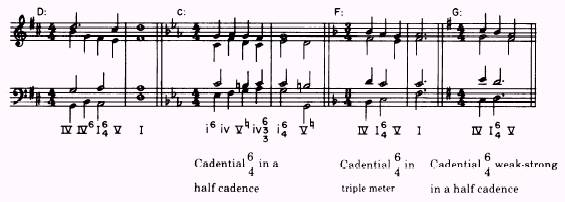
Cadential

The most widely used of all second inversions is the Cadential six-four, a second inversion tonic chord which moves to the dominant chord at a cadence. Normally, the sixth and fourth above the Bass note resolve down by step to a fifth and third respectively. A cadential six-four and its resolution to the dominant usually appear in a strong-weak rhythmic relationship. A weak-strong relationship may occur at a Half cadence. In triple meter it is often found on the second beat with the final tonic triad occurring on the first beat of the following measure.


FIGURE 6.7: Cadential Six-Four
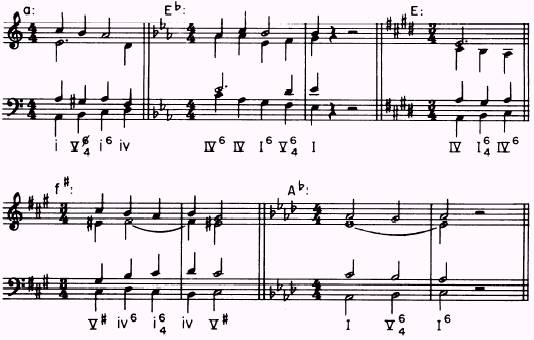
Passing
A passing six-four occurs when a second inversion chord appears between root position and first inversion of another chord. Therefore, may appear between a I and I6 or a I6 and I. may appear between a IV and IV6 or a IV6 and IV. Passing six-fours must appear in a weak rhythmic position.

FIGURE 6.8: Passing Six-Four
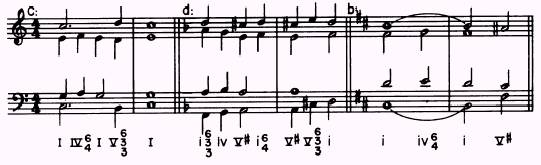
Auxiliary
An auxiliary six-four (also called a pedal six-four) occurs between two root positions of the same chord where the fifth of the auxiliary six-four is the same note as the root of the root position chord. Expressed in terms of voice motion, an auxiliary six-four occurs when the third and fifth of a root position triad, with root doubled, Auxiliary six-fours must occur in a weak rhythmic position. ascend by step and return.

FIGURE 6.9: Auxiliary Six-Four
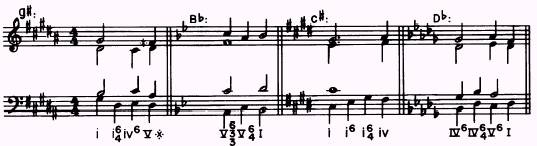
Arpeggiated
An arpeggiated six-four occurs when the second inversion of a chord is immediately preceded or followed by the same chord in root position and/ or first inversion.

FIGURE 6.10: Arpeggiated Six-Four

Back ] Home ] Up ] Next ]

This information is now available on CD in Adobe PDF Printable Format


Privacy Statement - Press Release - Copyright Information. - Contact Us - Support Integrated Publishing