| Tweet |

Custom Search
|
|
 
|
||
|
Packaging and Storing Backup rings are not color-coded or otherwise marked and must be identified from the packaging labels. The dash number following the military standard number found on the package indicates the size, and usually relates directly to the dash number of the O-rings for which the backup ring is dimensionally suited. Backup rings made of TFE do not deteriorate with age and do not have shelf life limitations. TFE backup rings are provided by manufacturer either in individually sealed packages or on mandrels. If unpackaged rings are stored for a long time without the use of mandrels, a condition of overlap may develop. Overlap occurs when the ID of the backup ring becomes smaller and its ends overlap each other. To correct this overlap condition, stack TFE rings on a mandrel of the correct diameter, and clamp the rings with their coils flat and parallel. Place the rings in an oven at a maximum temperature of 1770 C (350 0F) for approximately 10 minutes. Do not overheat them because fumes from decomposing TFE are toxic. Remove and water-quench the rings. Store the rings at room temperature before you use them (preferably for 48 hours).Installation Care must be taken in handling and installing backup rings. Do not insert them with sharp tools. Backup rings must be inspected prior to using them for evidence of compression damage, scratches, cuts, nicks, or frayed con-ditions. If O-rings are to be replaced where backup rings are installed in the same groove, never replace the O-ring without replacing the backup rings, or vice versa. Many seals use two backup rings, one on either side of the O-ring (fig. 7-12). Two backup rings are used primarily in situations (such as a reciprocating piston seal) where alternating pressure direction can cause packing to be extruded on both sides of the gland.
Figure 7-11.Types of backup rings.
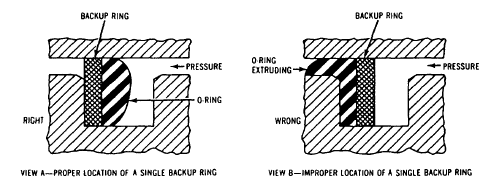
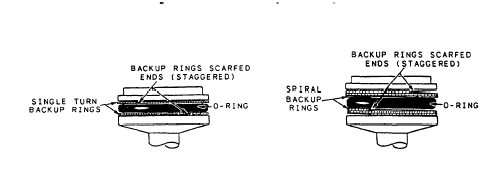
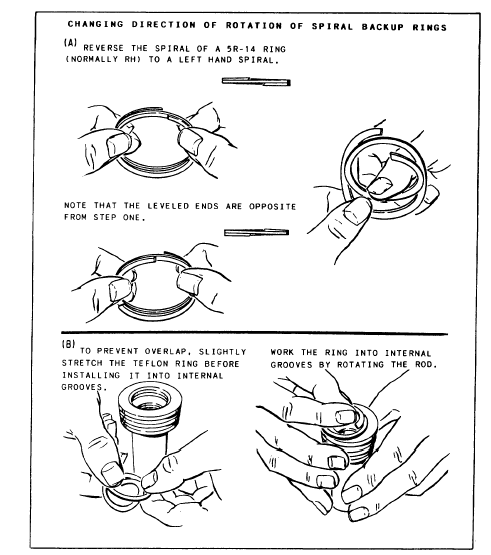
Figure 7-12.Backup ring configuration. If only one backup ring is used, place the backup ring on the low-pressure side of the packing (fig. 7-13, view A). When a backup ring is placed on the high-pressure side of the packing, the pressure against the relatively hard surface of the backup ring forces the softer packing against the low-pressure side of the gland, resulting in a rapid failure due to extrusion (fig. 7-13, view B). When dual backup rings are installed, stagger the split scarfed ends as shown in figure 7-14. When installing a spiral cut backup ring (MS28782 or MS28783), be sure to wind the ring correctly to ease installation and ensure optimum per-formance. When TFE spiral rings are being installed in internal grooves, the ring must have a right-hand
Figure 7-13.Location of a single backup ring.
Figure 7-14.Installation of cut dual backup rings.
Figure 7-15.Installation of TFE back up rings (internal). spiral. Figure 7-15, view A, shows how to change the direction of the spiral. The ring is then stretched slightly, as shown in view B prior to installation into the groove. While the TFE ring is being inserted into the groove, rotate the component in a clockwise direction. This will tend to expand the ring diameter and reduce the possibility of damaging the ring. When TFE spiral rings are being installed in external grooves, the ring should have a left-hand spiral. As the ring is being inserted into the groove, rotate the component in a clockwise direction. This action will tend to contract the ring diameter and reduce the possibility of damaging the ring.In applications where a leather backup ring is called for, place the smooth-grained side of the leather next to the ring. Do not cut leather backup rings. Use a leather backup ring as one continuous ring and lubricate the ring prior to installing it, particularly the smaller sizes. If stretching is necessary for proper installation, soak the backup ring in the system fluid or in an acceptable lubricant at room temperature for at least 30 minutes.QUAD-RINGS The Quad-Ring seal is a special configuration ring packing, manufactured by the Minnesota Rubber. As opposed to an O-ring, a Quad-Ring seal has a more square cross-sectional shape with rounded corners (fig. 7-16). The Quad-Ring seal design offers more stability than the O-ring design and practically eliminates the spiraling or twisting that is sometimes encountered with the O-ring. Quad-Rings seals are completely inter-changeable with O-rings in the sizes offered by the manufacturer. They may be installed with one
Figure 7-16.Quad-Ring. or two backup rings, depending upon the specific seal groove application and width. The Quad-Ring seal works well in, both hydraulic and pneumatic systems.Many Quad-Ring seal sizes have been assigned NSNs and are stocked in the Federal Supply System. Quad-Ring seals in manu-facturers sizes designated as Q1 through Q88 are interchangeable with O-rings conforming to AN6227. Likewise, Quad-Ring seals in com-mercial sizes Q101 through Q152 are inter-changeable with O-rings conforming to AN6230 in the respective dash sizes from 1 through52. Therefore, the Quad-Ring seal stock part number uses the AN standard O-ring designations AN6227 and AN6230 and the commercial Q dash number designation. For example, NSNs are found under such reference part numbers as AN6227Q10 and AN6230Q103. If the letter Q does not follow AN6227 or AN6230, the part number is an O-ring not a Quad-Ring seal. If Quad-Ring seals are not available for maintenance actions, appropriate sized O-rings can be installed and they work satisfactorily.QUAD-O-DYN SEALS The Quad-O-Dyn, also manufactured by Minnesota Rubber, is a special form of the Quad-Ring. The Quad-O-Dyn differs from the Quad-Ring in configuration (fig. 7-17), is harder, is subject to greater squeeze, and is made of a different material. The Quad-O-Dyn seal also works well in O-rings glands. The Quad-O-Dyn is used in relatively few applications. However, for difficult dynamic sealing applications, the Quad-O-Dyn can perform better than the Quad-Ring. Quad-O-Dyn rings are installed in submarine hydraulic systems plant accumulators.
Figure 7-17.Quad-O-Dyn seal. |
||
|
||