| Tweet |

Custom Search
|
|
 
|
||
|
PILE-DRIVING HAMMERS The three principal types of pile-driving hammers are the drop hammer, the steam, or pneumatic, hammer, and the diesel hammer. A drop hammer is a block of metal hoisted to a specific height and then dropped on a cap paced on the butt or head of the pile. Drop hammers weigh from 1,200 to 3,000 pounds. WARNING The noise generated by a pile driving operation can cause hearing loss. Hearing protection must be worn by personnel in the vicinity of pile driving operations.
Figure 12-58.-Spud clips mounted to one side of the piledriving hammer.
Figure 12-59.-Sheet pile driving with spud leads. The steam, or pneumatic, hammer has basically replaced the drop hammer. This hammer (fig. 12-60) consists of a cylinder that contains a steam-driven or air-driven ram. The ram consists of a piston equipped with a striking head. The hammer is rested on the butt or head of the pile for driving.
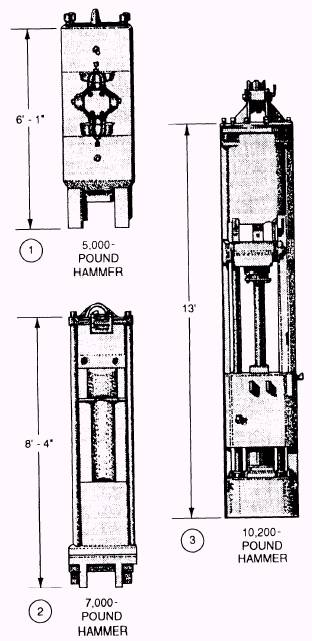
Figure 12-60.- Steam, or pneumatic, pile hammer. With a single-action steam, or pneumatic, hammer, the power drive serves only to lift the ram; the downward blow of the ram results from the force of gravity only. In a double-action hammer, the ram is both lifted and driven downward by the power drive. A double-action hammer weighs from 5,000 to 14,000 pounds, and a single-action hammer weighs about 10,000 pounds. The blows of the double-action hammer are lighter, but more rapid than those of the single-action hammer. The double-action hammer generally drives lightweight or average weight piles into soils of average density. The rapid blows tend to keep the pile in motion, thereby reducing the resistance of inertia and friction. However, when you are driving heavy piles in hard or dense soil, the resistance from inertia and friction, together with the rapid, high-velocity blows of the double-action hammer, tends to damage the butt or head of the pile. The single-action hammer is best for driving heavy piles into hard or dense soil. The heavy ram, striking at low velocity, allows more energy to be transferred into the motion of the pile, thereby reducing impact and damage to the butt or head of the pile. A conventional pneumatic hammer requires a 600-cubic-foot-per-minute compressor to operate, and the diesel is a self-contained unit constructed in sizes that deliver up to 43,000 foot-pounds of energy per blow. The diesel pile hammer is about twice as fast as a conventional pneumatic, or steam, hammer of like size and weight. |
||
|
||