| Tweet |

Custom Search
|
|
 
|
||
|
TYPES
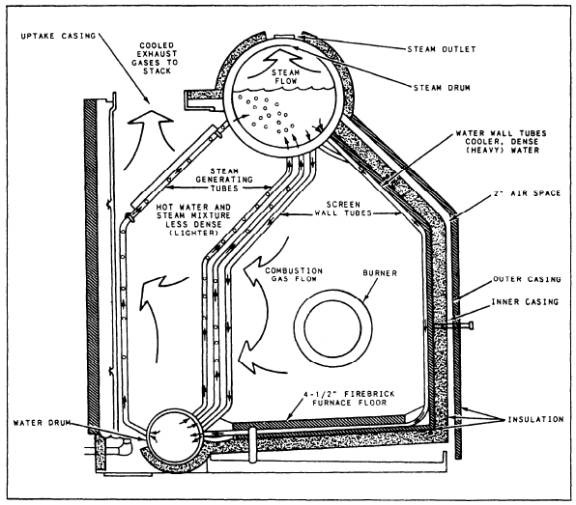
OF BOILERS Auxiliary boilers on Navy ships may be divided into two groups: FIRE-TUBE BOILERS and WATER-TUBE BOILERS. Fire-Tube Boilers Fire-tube boilers are generally similar to Scotch marine or locomotive boilers. In this type of boiler, the gases of combustion pass through tubes that are surrounded by water. There are a number of auxiliary boilers of the fire-tube type in use in diesel-driven ships. Figure 18-12 illustrates a cutaway view of the fire-tube boiler shown in figure 18-11. Water-Tube, Natural-Circulation Boilers Water-tube, natural-circulation boilers consist basically of a steam drum and a water drum connected by a bank of generating tubes. (See fig. 18-13.) The two drums are also connected by a row of water tubes, which forms a water-cooled sidewall opposite the tube bank. The water-wall tubes pass beneath the refractory furnace floor before they enter the water drum. In natural-circulation boilers, the steam and water
Figure 18-13.-Natural-circulation, water-tube boiler. drums are connected by several tubes of larger diameter, called DOWNCOMERS or WATER TUBES (not shown). These tubes are positioned away from the flow of hot gases of combustion. Refractory is also used to protect these downcomers from contact with the combustion gases. The operating principle of a natural-circulation boiler is quite simple. It relies on the difference in density (weight) between the cooler (heavier) water in the water tubes (or downcomers) and the hot, less dense (lighter) water in the steam-generating tubes. This is the force that causes the hot water and steam mixture to rise in the tubes in the generating bank, from the water drum to the steam drum, where the steam is separated from the water and rises to the top of the steam drum. The flow of water up the tubes of the steam-generating bank must be maintained; otherwise, the tubes would quickly melt. A constant flow of water and steam up the tubes is required to carry away heat at the proper rate. If the flow from natural circulation is allowed to stop, such as when the water level in the steam drum falls below the openings of the bank of tubes for the water wall, the tubes of the generating bank will be severely damaged and the boiler will need major repairs. (Replacing boiler tubes is an expensive operation.) |
||
|
||