Custom Search
|
|
 
|
||
|
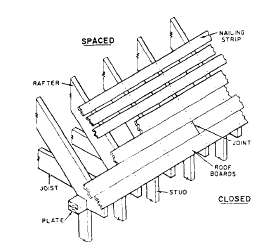
Roof Sheathing and Roof Covering Roof sheathing is the covering over the rafters or trusses and usually consists of nominal 1-in. lumber or plywood. In some types of flat or low-pitched roofs, wood roof planking or fiberboard roof decking might be used. Sheathing should be thick enough to span the supports and provide a solid base for fastening the roofing materials. Generally, third grade species of lumber, such as pines, redwoods, and hemlocks, are used as roof sheathing boards.Board roof sheathing (fig. 6-39) used under asphalt shingles, metal sheet roofing, or other
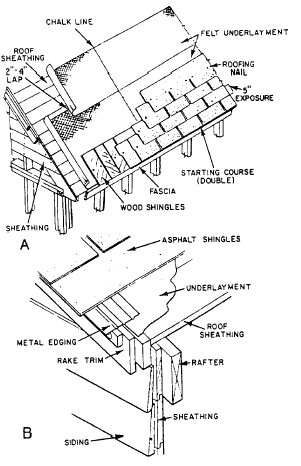
Figure 6-39.-Typical board roof sheathing, showing both closed and spaced types. roofing materials that require continuous support should be laid closed (without spacing); however, when wood shingles or shakes are used in damp climates, it is common to have spaced roof boards (fig. 6-39). When plywood roof sheathing is used, it should be laid with the grain perpendicular to the rafter (fig. 6-40). Roof covering materials used for pitched roofs are wood, asphalt shingles, tiles and slate, galvanized iron (GI) sheets, and several other sheet materials. For flat or low-pitched roofs, a built-up construction is also used. An asphalt-saturated felt underpayment called ROOFING FELT is applied over the roof sheathing before the roof covering is installed. The roofing felt serves three basic purposes: It keeps the roof sheathing dry until the shingles can be applied, it acts as a secondary barrier against wind-driven rain and snow, and it protects the shingles from any resinous substance that may be released from the sheathing. The method of laying an asphalt-shingle roof is shown in figure 6-41. The roofing rolls are usually 36 in. wide with a 2 in. to 4 in. overlap. The shingles are usually laid with 5 in. exposed to the weather. Figure 6-42 shows installation of wood shingles. Wood shingles are available in
Figure 6-40.-Application of plywood roof sheathing.
Figure 6-41.-Application of asphalt shingles: A. Common method with strip shingles; B. Metal edging at gable end.
Figure 6-42.-Installation of wood shingles.
Figure 6-43-A typical building paper and felt on five-ply built-up roof. three standard lengths: 16, 18, and 24 in. The 16-in. length is perhaps the most popular. Wood shakes are applied in much the same manner as wood shingles. On flat roofs, the roof covering is usually built up. BUILT-UP ROOFING consists of several layers (plies) of felt, set in a hot binder of melted pitch or asphalt. Built-up roofs are always designated by the number of plies they contain. A five-ply built-up roof is shown in figure 6-43, Notice that aggregate surfacing materials, such as gravel, slag, marble, and other suitable materials, are used in built-up roofing to provide a good weathering surface and protect the bitumens from sunlight and external heat. |
||
|
||