|
||
|
|
||
|
Page Title:
Forecasting stratus formation and dissipation |
||
| |||||||||||||||
|
|
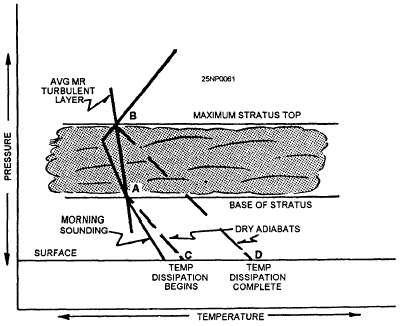
Click here to Order your Radar Equipment Online FORECASTING STRATUS FORMATION AND DISSIPATIONFog and stratus forecasting are so closely tied together that many of the fog forecasting rules and conditions previously mentioned also apply to the forecasting of stratus clouds.Determining the Base and Top of a Stratus LayerOne of the first steps in forecasting the dissipation of stratus is to determine the thickness of the stratus layer. The procedure is an follows:1. Determine a representative mixing ratio between the surface and the base of the inversion.2. Project this mixing ratio line upward through the sounding.3. The intersection of the average mixing ratio line with the temperature curve gives the approximate base and maximum top of the stratus. Point A in figure 5-19 is the base of the stratus layer, and point B is the maximum top of the layer. Point A is the initial base of the layer; but as heating occurs during the morning, the base will lift. Point B represents the maximum top of the stratus layer; although in the very early morning, it might lie closer to the base of the inversion. However, as heating occurs during the day, the top of the stratus layer will also rise and will be approximated by point B.If the temperature and the dewpoint are the same at the top of the inversion, the stratus will extend to this level. To determine the height of the base and the top of the stratus layer, use either the method previously outlined for fog, or the pressure altitude scale.Determining Dissipation Temperatures To determine the temperature necessary for the dissipation of a stratus layer, the following steps are provided:1. From point A in figure 5-19, follow the dry adiabat to the surface level. The temperature of the dry adiabat at the surface level is the temperature required to be reached for stratus dissipation to begin. This is point C.
Figure 5-19.-Sounding showing the base and the top of stratus layers. Also note temperature at which dissipation begins and temperature when dissipation is complete.2. From point B in figure 5-19, follow the dry adiabat to the surface level. The temperature of the dry adiabat at the surface level is the surface temperature required for the dissipation of the stratus layer to be complete. This is point D.This information is now available on CD in Adobe PDF Printable Format |
|
Privacy Statement - Press Release - Copyright Information. - Contact Us - Support Integrated Publishing |