Custom Search
|
|
 
|
||
|
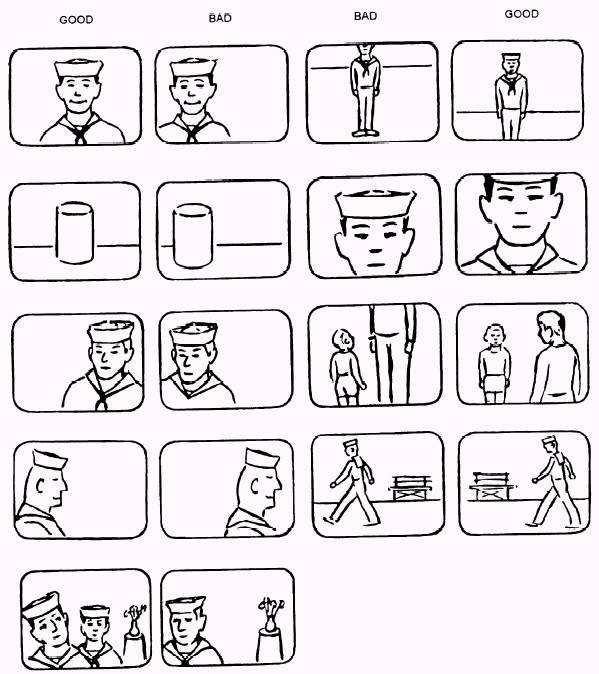
Video images, like still photographs, are subject to the aesthetic rules of picture composition. There are, however, factors peculiar to video that more or less influence television composition. These factors are as follows: The small monitor requires objects to be shown relatively large so they can be seen clearly on a small screen. You must shoot more extreme close-ups (ECU), close-ups (CU), medium shots (MS), few long shots (LS), and very few extreme long shots (ELS). The 3:4 aspect ratio of the picture cannot be changed so all picture elements must be composed to fit it. The aspect ratio is the ratio of picture height to width. There is no vertical format in television. You must always think horizontal format. The video camera is the eyes of the viewer. Therefore, camera movement, as well as the static arrangement of elements within the frame, must be considered. When shooting uncontrolled action, you may not be able to predetermine composition. Sometimes all you can do is correct certain compositional errors. In motion media, the picture on the screen is referred to as a shot. A shot is one continuous camera run from the time the recording starts to the time the recording stops. A shot may last a few seconds, several minutes, or the entire program. A motion-video cameraperson must always think in terms of shots. Most rules of composition in still photography apply equally well to composition in motion media. Composition was covered earlier in chapter 5. The
Figure 13-9. TV framing.
Figure 13-10. Long shot, medium shot, and closeup shot progression. simple line drawing examples of TV framing (fig. 13-9) indicates how to stage and show elements within the confines of the small 3:4 fixed aspect ratio of a television picture. Use high- and low-camera angles with caution. High angles tend to shorten the legs of a person. Low angles may distort the body and face of the subject. Of course, watch for objects that seem to be growing out of or are balanced on a person's head. Area of Talent Included Most motion-media assignments involve people. You may find it convenient to identify people shots by the section of the body that is included in the frame. The person's head is usually in the top of the picture; therefore, shots vary according to the lowest part of the talent shown at the bottom of the screen. Thus the terms used to describe various people shots are as follows: full figure shot, knee shot, thigh shot, waist shot, bust shot, head shot, tight head shot. Number of People Included The shot designations that are easiest to remember are the ones that refer to the number of people included in the picture. When only one person is to be shot, it is a one-shot. Obviously, a shot that shows two people is a two-shot, three people make a three-shot, and so on; however, when five or six people are pictured it is called a group-shot. A crowd-shot is when a large group of 20 or more people is being framed. |
 |
|
|
||