Custom Search
|
|
 
|
||
|
The subtractive type of color enlarger uses a dial-in dichroic filtration system. This type of color enlarger has three filtration controls that move yellow, cyan, and magenta filters into the path of the exposing light. Segments of the dichroic filters are moved in and out of the exposing light beam on calibrated cams. This type of filtration system provides accurate and repeatable filter pack combinations. Most color enlargers use a tungsten-halogen light source. These light sources produce a great amount of heat. When a tungsten-halogen light source is used, the color printer must have forced-air cooling fans in addition to the heat-absorbing glass. An ultraviolet absorber, such as a Kodak Wratten Filter No. 2B (CP2B), must always be included in the light beam, preferably above the negative. The most common type of subtractive printer used in the Navy is the Chromega D dichroic enlarger. NOTE: Never touch a tungsten-halogen bulb. Handle it only by the edges or reflector cone. Oil from your fingers can heat up and create a hot spot on the light bulb, causing it to burn out. If you touch the bulb, clean it with a soft cloth and isopropyl alcohol. Allow the bulb to dry thoroughly before energizing. ADDITIVE PRINTERS The additive type of color enlarger uses the additive or primary colors of light (red, green, and blue) to expose color printing paper. This type of enlarger uses
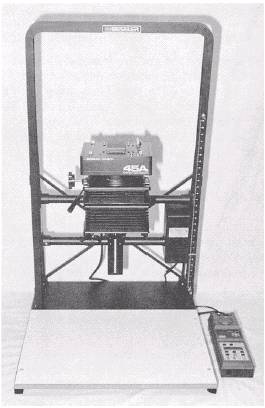
PH2 Myer III 302.260 Figure 12-3. Bessler Model 45A color enlarger. filters either above the negative (CP filters) or below the lens (CC filters) to control the color quality of the exposing light. Bessler color enlargers (fig. 12-3) are used in many Navy imaging facilities. The Bessler Model 45A uses pulsed-xenon tubes to expose the color printing paper. The xenon tubes are mounted at the top of the head of the enlarger above red, green, and blue filters. The amount of red, green, and blue light is controlled by the number of flashes through each color filter. By adjusting the number or length of time that the filtered-light sources flash, you can correct the color balance of the print. The color head of the enlarger is normally programmed to a color analyzer that is used to provide acceptable color prints. |
 |
|
|
||