Custom Search
|
|
 
|
||
|
As you know, most black-and-white photographic images on film emulsions are made of fine grains of silver. Because of this silver grain structure, enlargements, especially large ones, may appear grainy. The graininess of a print is a direct result of the graininess of the negative and the degree of enlargement. The graininess of a print, however, may be modified to a limited extent during the printing stage by the following techniques: The diffusion enlarger should be used where negative graininess is serious and objectionable in the print. The appearance of graininess in the print can be reduced by using a rough, surface paper instead of a smooth, glossy paper. A diffuser used between the enlarger lens and the printing paper helps subdue the appearance of grain. Crumpled cellophane, fine mesh screen, or a piece of nylon stocking can be used as a diffuser. The enlarger can be set to project an image that is slightly out of focus. The permissible graininess in a print depends very much on the viewing conditions. For a large display print to be viewed from a relatively great distance, more graininess can be tolerated as compared to a smaller print held in a person's hand for viewing.
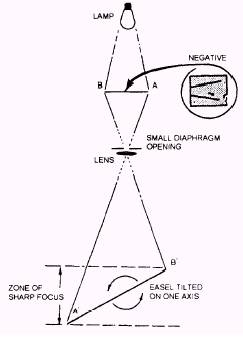
Figure 11-17. Distortion corrected by tilting the easel. DISTORTION CONTROL When you tilt the camera upward to make a picture of a tall building, the vertical lines converge and the building walls seem to be at the point of collapsing. A view camera is equipped with movements that allow the film to be parallel, or nearly so, with the subject, in spite of the viewpoint; however, most of the negatives you print probably are not made with a view camera. Many negatives show an undesirable, noticeable convergence of lines. Changes in these images can be made by tilting the head on some enlargers or by tilting the easel and paper to correct image distortion (fig. 11-17). Most enlargers have an easel separate from the enlarger. Because the easel is separate, it can be tilted by blocking it up on one end. A small diaphragm opening (high f/stop) must be used to increase the depth of focus to include both the part of the easel nearest the lens and the part of the easel farthest from the lens. Within the limits of what you can keep in focus, you can correct some or all of the distortion. With some enlargers, you can tilt the negative carrier by propping up one side with one or more coins. One big disadvantage of tilting the easel is that an extremely small diaphragm opening must be used for depth of sharp focus. The use of a small diaphragm opening makes focusing and composition difficult. This makes it necessary to use long exposure times. |
 |
|
|
||