Custom Search
|
|
 
|
||
|
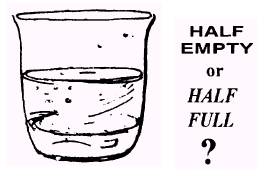
ATTITUDE Attitude can be described as the tendency to move toward a situation or away from it. It results from either a positive or negative outlook or feeling toward a subject. It involves a like or dislike (based on a habit, a previously formed opinion, or a current snap judgment) for someone or something. The following illustration, provided by a television spot concerning human behavior, is a good example of a positive-negative outlook: Look at the glass below. Is it
Do you see the filled portion or the empty portion of the glass? Do you see "what is" and resolve to make the most of it, or do you see and resent "what is not"? Attitudes can't be measured or graded, but the effect or results of our attitudes can be. "They are apparent in our actions and performance. You may have said or heard someone else say, "That person has a poor attitude." How was this opinion formed? Was it formed as the result of the way that person acted toward coworkers or customers or the way that person completed his or her work? Let us look at some specific instances in which attitude plays a big part. Consider an aircraft mechanic in the process of making a preventive maintenance (PM) check on a jet engine. Suppose the mechanic sees a loose wire or a badly worn part not included on the PM card but does nothing about it. On a flight the next day, the engine malfunctions and flight operations are disrupted. Was the mechanic's neglect a dereliction of duty? Probably! However, we are not considering the legal aspects of the act, but the negative attitude that prompted it. Similarly, a negative attitude is demonstrated by the cook who scorches the eggs, the liberty boat coxswain who drives into every wave, or the Hospitalman (HM) who loses your shot record. The mechanic isn't going up in the plane. The cook has already eaten. The coxswain is in the duty section. The HM isn't going to have a sore arm as a result of the shots. These people aren't interested in doing a good job; they just want to get through the day. People are said to have a positive attitude toward a situation or person when the consequences are pleasant or desirable. For example, you may be said to have a positive attitude toward a friend because you enjoy the friend's company. You are said to exhibit a negative attitude toward an individual or situation when the consequences are painful or otherwise undesirable. For example, you drive carefully because of your concern for the safety of your passengers as well as the other drivers. Why bother talking about attitudes? After all, people are people, and you can't change human nature. Not true! Human nature constantly changes-as attitudes change. How do attitudes change? First, YOU must become aware of the desirability and advantage of change. Second, YOU have to change your attitude-no one can do it for you. SN Doe is assigned to a galley working party by his leading petty officer (LPO). SN Doe is angry that he has been given this detail again. AN Frost is assigned to the same detail by his LPO. Both sailors show up for the working party. Doe tells Frost that he is tired of working parties and he feels he shouldn't be there. He says he is going to request to see the captain to find out why he is assigned to so many working parties. Frost says, "Hey man, working parties don't last forever; besides the work we do helps everybody. It provides service to the galley so that the crew gets good hot chow, and we do not have to eat sea rations." Pride Since our attitude toward others is a reflection of our attitude toward ourselves, we must have a proper appreciation of ourselves. We should not be too impressed with our accomplishments, nor should we be excessively critical of them. Staying in touch with reality is a excellent approach to developing a healthy attitude. You may not be all that you would like to be; but you are who you are, and you should feel good about that. You are valued as a person, you have accomplished certain things, and you have the ability to climb higher. Recognizing who you are, what you are, and what you hope to become will enable you to meet each day with an expectation of winning rather than a certainty of defeat. Without a degree of pride in yourself, your ability, and your job, you are unlikely to put forth your best effort. You are more likely to perform only when told to do so, and then only at a minimal acceptable performance level. Courtesy Regulations do not require courtesy beyond that required for formal military protocol. Formal courtesy is that which is demanded by custom and tradition, and failure to observe it can result in unpleasant consequences. But, common courtesy is a totally different subject. Common courtesy goes beyond what we are required to do. It is a voluntary expression of respect for another's rights or feelings. It is opening a door for someone heavily laden with packages. It is showing military courtesy and respect for a person rather than merely giving the required recognition. It is treating the customer as a person with a problem that is important.
You can probably "get by" if you do just what is required by the organization chart, a job description, or specific instructions, but cooperation smooths a lot of rough spots. Being cooperative is working WITH the other members of the team for the purpose of improving individual performance and overall efficiency. Cooperation is necessary when "breaking in" a new member of your organization. Mary has just been assigned to your office, and it's up to you to help her get started on a job that she has never done before. You could just show her how to perform the mechanics of the job and let her muddle through on her own. But wouldn't explaining the job and telling her where to find answers to her questions make her job easier and her job performance better? Doing that also has a practical application-it can prevent many mistakes you may have to correct. An element of cooperation is required when responding to customers' needs. They will often need information or assistance from another office before you can act on their request. You can send them on a "wild goose chase" to get it; or you can provide them with specific instructions on what to get, where to get it, and how to get it. You might also make a phone call so that they will be expected. Behavior Our behavior (the things we choose to do or not to do) is the result of our attitude (our reasons for doing or not doing those things). Our behavior on the job is affected by our attitude toward our job, our coworkers, the customers, and the Navy. But another set of attitudes (not job related) also influences our performance on the job. Let us try to provide an example to show how attitudes are developed. Walter T. Door rolls out of his bunk as reveille is sounded and heads for the shower in preparation for another day at sea. But, there is no hot water! With a few caustic comments about the "water king," he proceeds to shave-in cold water. By now, his mutterings include the entire "A" gang. Splashing aftershave lotion on his scraped and burned" face, he starts back to his locker only to stub his toe on the hatch. Grabbing his throbbing toe, Poor Walter drops his toilet kit. Any other time the contents of the kit would have only spilled, but this morning his new bottle of shaving lotion breaks. Walter's fuse is getting shorter. As he dresses, he fumes at the missing shirt button and the fact that both socks are inside out. He shoves his feet into his shoes, very much aware of the injured toe, and decides not to tie his shoe laces. Now, he goes to breakfast. The menu lists a favorite, ham and eggs to order. But Walter is late, and the mess is now serving fried bologna and scrambled eggs. Walter finally gets to the office. What do you think his attitude will be when the division petty officer walks up and says, "Walter, we have an UNREP scheduled for 0930 today. According to the working party rotation list, you are next in line. The storehandling team will muster at 0915 on the fantail." Everyone has days like that one experienced by Walter. They are just a slice of what we call life experiences, and these occurrences can greatly influence on-the-job performance and attitude. However, you must strive not to let them negatively influence yours. It's no easy task to overcome them, but overcome them you must if you are to respond to the customer and to your coworkers as you should. Though customers are not responsible for such events, they are often the victims of poor service because of them. |
 |
|
|
||