Custom Search
|
|
 
|
||
|
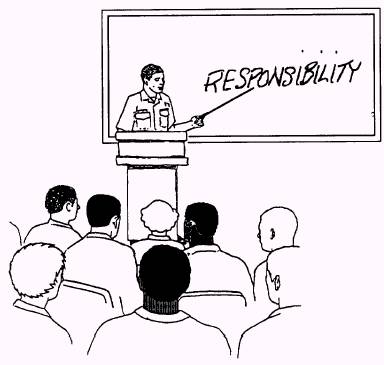
CREATING A POSITIVE ATMOSPHERE We have already discussed the influence that the member exerts on the contact point. Now let's consider the other side of influence. How much does the atmosphere of the contact point (the general attitude of all team members) affect each team member individually? As the supervisor or other senior member of a team, you exert the greatest amount of influence on that team. As the leader, not only are you the one who sets the example for the rest of the team, you are the one who creates either a positive or a negative atmosphere. Refer to Case No. 3. LPO Brush provided a negative atmosphere through two poor work habits. First, he used profanity and allowed other members to use it. Second, he measured office effectiveness by empty baskets rather than by the quality of response to customer needs. A contact point representative may read chapter 3 of this book carefully and fully intend to implement its "do this" and "don't do that" advice. However, the extent to which the representative may apply that advice depends largely on the contact point atmosphere. You must take the lead in developing and reinforcing an atmosphere that improves teamwork. Each team develops its own standards for performance and behavior. These standards are a composite of the standards of all of its members, which must be acceptable by the contact point supervisor. The team then exerts its influence on each member to conform to those standards. New members being indoctrinated in their duties are aware of the attitude of the team toward those standards. As they develop their job skills, they will likely develop and accept a similar attitude. Setting a good example is the best possible method of creating a positive atmosphere. When team members see that you have a positive attitude toward work, they will follow your example. As new members develop their work habits, they will look not only at the example you set, but at the example set by other team members. ENCOURAGING THE ACCEPTANCE OF RESPONSIBILITY Chapter 1 stated that there are no unimportant jobs when you are performing a personal service or supplying a personal need. You can carry this statement a step further- there are no unimportant jobs. The output from a particular job may have doubtful value, but the performance of that job is important to the performer. The performer must be able to see some worth in the job to maintain a sense of personal worth. If convinced that the job has no purpose or value, the performer assumes that the supervisor considers the job to be of little value. At times, a person's ability far exceeds the ability required to perform an assigned job. When you make such assignments, explain the reason for the assignment and the value of the job. That will help confirm the person's sense of personal worth and, thus, improve teamwork. The following are examples of explanations you might use: . This job isn't as challenging as other jobs that you have had in the past but, it is certainly as important. To make this point, it is part of our training rotation. I know that you will do well. . This work must be kept on schedule; I trust you will do that in my absence. . You'll be starting your new assignment next week. In the meantime. . . You may stimulate the initiative of a new member by using the job assignment itself. Let the member know that this is the first in a series of assignments that will increase in responsibility with each job change. You may stimulate the initiative of a new member by using job assignments as the first in a series of increases in responsibility. The Navy's most valuable asset-people-is wasted when they are told to "look" busy. Supervisors who instruct their people to look busy demonstrate their own lack of initiative (poor planning) and destroy initiative in team members. Supervision can stimulate a team to better performance, or it can smother any initiative. Suppose a supervisor asks, "Can't you people do anything on your own?" Then the supervisor constantly looks over the workers' shoulders and criticizes their work. The supervisor's action has answered the question: No, the members can't do anything on their own; the supervisor won't let them. You must keep the lines of communication open. Though you must encourage members to work on their own, you must assure them that they can come to you for answers when the need arises. Your response may vary, depending upon the need and the person, but it should not lead the member to an endless, aimless search. You can take three steps to encourage team members to assume responsibility: 1. Recognize their ability. 2. Set goals for them. 3. Acknowledge their achievements.
Recognizing Ability To recognize abilities is to recognize the individual. If we were to randomly select a Navy rating and then from that rating select a rate, these people would be as different in their abilities as they are in appearance. Matching job requirements to individual abilities is just good management. This job match should not be looked upon as being permanent, but as a logical beginning for training. Setting Goals "This instruction just came in. I want you to study it." This supervisor has given the team members one reason they should read the instruction: "I want. . ." This approach gives them no motivation to read it; they do not know how, why, or when to use the instruction? A different approach would provide more motivation: "We just received this instruction covering new pay procedures that will go into effect the first of the month. I'll route it around so that all of you can read it. Next week, we will have a training session on the contents." Using this approach, the supervisor has told them how, why and when. Goals must be meaningful and realistic if team members are to consider them seriously. Ideally, goals should be set just above the level that the person is currently achieving. If they are too low, there is no challenge-the goal has already been met. If they are too high, the member is likely to reject them. If failure is certain, why go to the trouble of trying? Goals may be set for individuals or for the team. They may be set as a part of, or in connection with, the division training program. Acknowledging Achievements Rare, indeed, is the person who will conscientiously do a job, day after day, without some recognition. Members normally receive recognition for performance at the outstanding performance level. However, those who perform considerably below the level of outstanding also need to receive recognition. Make an effort to recognize those personnel who perform at a less notable level. The following are some examples of the positive effects of such recognition: . The new member is just learning the job. Recognition of achievement may provide a needed boost toward increased ability. l l The "plodder" has shown unusual initiative. Recognition may be the incentive needed to pull that person out of a rut. The capable, dependable member always does a good job. Recognition communicates your awareness of and your appreciation for that person's performance. For whatever reason recognition is given, it must be honest. The member usually knows when performance has been satisfactory and when it has not. Regardless of whether the job is good or bad, say so. If for some reason it happens to be bad, say why. Indiscriminate flattery can be as bad as no recognition. After all, if the member gets a pat on the back for every job-good or bad-where is the incentive to do a good job? |
 |
|
|
||