Custom Search
|
|
 
|
||
|
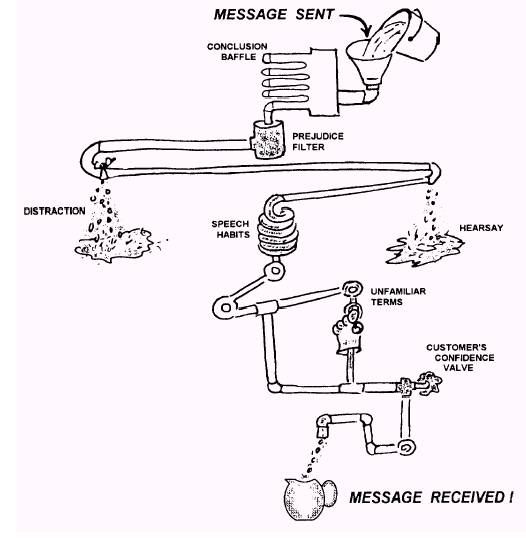
FAILING TO COMMUNICATE Communication requires more than just talking. One person cannot communicate. Communication involves a sender and a receiver and a message understood by both. The sender must be able to select words or visual signals that accurately convey the desired meaning and can be understood by the receiver. All responsibility does not rest on the sender; the receiver must hear what is being said. When interference (lack of understanding or distractions) garbles the message, the receiver should ask the sender to repeat or explain the message. Misunderstanding information may be worse than receiving no information since it can result in disappointment, frustration, missed opportunity, or improper action by the receiver. Sometimes it seems that you can almost see the earplugs in a customer's ears. What you are saying is not getting through. You may be tempted to shrug the incident off by saying, "I did my part. It's not my fault if the customer wouldn't listen." Are you sure that you did your part? After all, the customer came to you for information or advice but didn't receive it. Any one of several causes could have interfered with your message: l l l l l l l l The customer was vague about the particulars of the problem. You communicated with jargon, unfamiliar terms, or slang. You didn't make your explanation as thorough as you should have. You communicated or inferred that the customer or problem wasn't important. The customer had other problems. The customer felt rushed. The customer lacked confidence in your ability to provide the requested service. You failed to make sure that the customer understood. Several types of language barriers can interfere with effective communications. Cultural differences, physical problems, language that reflects bigotry or prejudice, speech habits, and confusing terminology all can create a barrier to communication. However, the first two barriers-cultural differences and physical problems-are the most difficult for the speaker to
overcome. You, the customer, or both you and the customer may cause the barrier. Overcoming Cultural Differences Persons for whom English is a second language often have difficulty with pronunciation and sentence structure. English is considered one of the most difficult languages to learn. Words that sound alike have completely different spellings and meanings, and words with similar spellings are pronounced differently. You cannot change the language, but you can overcome the barrier. First you must listen with CARE and be sure that you know the nature of the need or problem; show an honest concern for what is being said. Then, carefully phrase your questions, using relatively simple words; ask only one thing at a time. By first determining the nature of the problem, you will be able ask questions to gain additional information. The customer who has difficulty speaking English also may have trouble understanding it. When the customer has difficulty understanding, speak more distinctly and more slowy. Watch the person's facial expressions for signs of misunderstanding. Overcoming Physical Problems Speech impediments, such as stuttering or lisping, also cause misunderstanding. We did not list speech problems in our discussion of causes for adverse reactions. However, in some instances they may cause a negative reaction. You may react negatively to the person who has difficulty speaking, and that person may react negativey to your inability to communicate with him or her. The person with a speech problem is frequently sensitive about that problem and will resent any exaggerated manner of speaking on your part to overcome it. To overcome this barrier, maintain a positive attitude and concentrate on understanding the speaker's words rather than the speaker's choice of words. Avoiding Language That Reflects Prejudice and Bigotry A major roadblock to effective communication is the use of words that reflect prejudice and bigotry. Such words show derision and deny the equality of another person. They give those who use them a false sense of superiority. They also reflect the personal characteristics of the speaker. Prejudice and bigotry and the use of words that reflect those characteristics stem from fear, ignorance, and superstitions. Any term that shows derision could be included in this category, including commonly used terms such as snipe and deck ape. People use words of prejudice and bigotry as a judging device-to size people up and to evaluate their traits. Using such terms relieves them of the need to know the person. The fallacy of this practice is that their actions reflect their attitudes and alienate the very person they are trying to help. Everyone has prejudices of some kind. They are a part of our emotional character and the preconceived opinions we have of a person based on insufficient evidence. However, prejudices are directly opposed to our constitutional concept of justice-that a person is presumed innocent until judged guilty. Rooting out prejudice takes time and effort, but the results are well worth it. In the meantime, make a constant, conscious effort not to use words that create resentment and anger. Improving Speech Habits Some speech habits, such as slurred pronunciation, running words together, speaking too fast, exaggerated drawl or brogue, and profanity, interfere with understanding. When a customer with one of these speech defects comes to you for service, concentrate on WHAT is being said-not HOW it is said. That will keep the distraction to a minimum. The speech of the contact point representative may create a language barrier as well as that of the customer. Therefore, you should analyze your own speech pattern to determine whether you need to improve your manner of speaking. It's possible that you may have one or more of the habits discussed here. Normally, we don't listen to our own speech, but you can get a reasonably accurate sample of your speech habits by recording an informal conversation and then listening to it carefully. Disturbing speech habits are not too hard to change, but first you must be aware that you have them. If you find that your speech creates a language barrier, make an conscious effort either to eliminate the problem or to compensate for it. To compensate, speak slowly and give the listener time to follow and interpret what you are saying or to ask questions. Avoiding Confusing Terminology The contact point representative sets the final barrier through the use of jargon, technical terms, and acronyms that confuse the customer. Using these terms and acronyms among coworkers who are familiar with them is okay. However, do not use them when speaking to the customer who is not familiar with them. |
 |
|
|
||